LS26 - Targeted Prevention
- LS26 Targeted Prevention / Key Facts
- LS26 Targeted Prevention / Call Specifications
- LS26 Targeted Prevention / Scope of the Call
- LS26 Targeted Prevention / Structure of the Call
- LS26 Targeted Prevention / Roles of Applicants
- LS26 Targeted Prevention / Joint Projects with Partners in Lower Austria
- LS26 Targeted Prevention / Structure of the Proposal
- LS26 Targeted Prevention / Eligible Costs
- LS26 Targeted Prevention / Gender Aspects in the Application Phase
- LS26 Targeted Prevention / Good Scientific Practice and Ethics
- LS26 Targeted Prevention / Open Science
- LS26 Targeted Prevention / Submission
- LS26 Targeted Prevention / Evaluation Criteria
- LS26 Targeted Prevention / Selection and Decision Processes
- LS26 Targeted Prevention / Funded Projects
- LS26 Targeted Prevention / Submission Guideline / Full Proposal
- LS26 / Full Proposal / Key information
- LS26 / Full Proposal / Accessing your proposal
- LS26 / Full Proposal / Update information about PIs
- LS26 / Full Proposal / Overview of chapters
- LS26 / Full Proposal / Details of chapters
- LS26 / Full Proposal / Signatures
- LS26 / Full Proposal / Proposal submission
- LS25 / Full Proposal / Applicant Response Phase
- LS26 Targeted Prevention / WWTF Contacts
LS26 Targeted Prevention / Key Facts
This call is open to research projects that have the potential to promote disease prevention and/or increase the number of healthy life years in a defined human population.
Call scope
Projects must identify a specific risk population, define a disease/health condition, and develop an actionable mechanism for intervention. Scientific innovation and its value in addressing an open research gap in prevention research must be clearly demonstrated. In addition, projects must outline a pathway to implementation that allows for the assessment of the feasibility and impact of the proposed work. Project teams must demonstrate scientific expertise in relevant research disciplines, as well as further expertise from relevant stakeholders. Budget may be allocated for non-academic stakeholders as appropriate.
Who can apply?
Projects are led by a "core research team" of up to three principal investigators (PIs). The core research team consists of:
- A coordinating PI (PI&C), who must be based at a university or research institute in Vienna
- Up to two co-PIs, who may be based anywhere globally (i.e., Vienna, Austria, internationally)
- Co-PIs outside of Vienna may receive a maximum total of 20% of the total budget
- Co-PIs affiliated to institutions in Lower Austria may receive a maximum total of 49% of the total budget in Joint Projects
Project duration
24–48 months
Funding
- Call budget: € 7.5 million
- Project budget: € 400,000 to € 750,000 (up to € 800,000 for Joint Projects)
- Personnel and non-personnel costs may be claimed
- Maximum 40% non-personnel costs
- Up to 20% overhead costs
Timeline
- Call opening: March 3rd, 2026
- Short Proposal deadline: May 5th, 2026, 2pm CET
- Full Proposal deadline: October 6th, 2026, 2pm CET
- Applicant response phase: between February 8th - 19th, 2027 (exact dates TBD)
- Expected funding decision: late March, 2027
-
Project start: latest September, 2027
Process
- Two-stage selection process
- International jury
- International peer review
- Application via WWTF Funding Portal
Info event
- Online information session about the call: March 17th, 2026, 10am - 12pm CET
- Zoom: https://us02web.zoom.us/j/84627777408
- Webinar ID: 846 2777 7408
LS26 Targeted Prevention / Call Specifications
This repository contains key information for the LS26 Targeted Prevention project call
LS26 Targeted Prevention / Scope of the Call
The aim of this call is to enable innovative and impactful research that has the potential to promote disease prevention and/or increase the number of healthy life years in a defined human population. Projects should seek to improve a specific health condition or the prevention of a specific disease by developing targeted interventions for that population.
Key requirements
Please consider the following key requirements for all projects in this call:
- Projects must identify a specific risk population (e.g., genetic background, demographic/socioeconomic group), define a disease or health condition (e.g., cardiovascular, mental, infectious), and develop an actionable mechanism for intervention (e.g., pharmaceutical, lifestyle, social, policy-based).
- Projects must demonstrate scientific innovation (e.g., new biological mechanism, screening technology, method of engaging target population) and the value of this innovation in addressing an open research gap in prevention research.
- Projects must outline a pathway to implementation that allows for the assessment of the feasibility and impact of the proposed work (e.g., inclusion of consultations with target group, co-development frameworks, health economic considerations)
- Project teams should demonstrate scientific expertise from relevant research disciplines, as well as further expertise (e.g., on lived experience, implementation barriers, etc.) from relevant stakeholders (e.g., patient groups, advocates, practitioners, policymakers). Budget may be allocated for non-academic stakeholders as appropriate.
Proposals must fulfil all requirements to be considered within the scope of the call. Should any single requirement not be addressed, the proposal will be deemed out of scope and not further evaluated.
Further considerations
This call takes an inclusive approach to prevention, both with respect to the the health conditions to be addressed and the modalities of intervention. While "targeted prevention" shares thematic elements with biomedical/clinical and public health research, the focus of this call is the development of evidence-based preventative interventions that are innovative and impactful for a particular risk group. In addition to fulfiling all key requirements, please also consider the following:
- This call is open to research focusing on diverse aspects of health and disease, including physical, cognitive, mental, social well-being, etc.
- Research focusing on primary or secondary prevention and covering the entire lifespan is within the scope of this call.
- This call encourages research that considers various intervention modalities, including clinical, pharmaceutical, behavioural, environmental, social, and policy-based approaches.
- Research should go beyond improving understanding of the aetiology or epidemiology of diseases and encompass the development and piloting of interventions for their prevention.
- This call encourages projects that aim to develop interventions for populations that are underrepresented, marginalised or disproportionately affected by a health/disease condition. However, research focusing solely on health disparities (e.g. the social determinants of health) does not fulfil the requirements of this call.
- Projects should ensure appropriate involvement of the risk populations and relevant data from these populations. Applicants must consider ethical and legal requirements, the quality and quantity of data required for sufficiently powered studies, and the timeliness of acquiring data.
- Based on recent experience, WWTF considers gaining access to data from health insurance institutions in Austria to be extremely difficult, even when an initial commitment to data access has been provided. Negotiations with these organisations regarding data access may exceed the project’s timeframe.
- Based on recent experience, WWTF considers gaining access to data from health insurance institutions in Austria to be extremely difficult, even when an initial commitment to data access has been provided. Negotiations with these organisations regarding data access may exceed the project’s timeframe.
Outside of scope
The following types of projects are deemed to be outside the scope of this call:
- Projects that focus solely on data collection or establishing registries without also involving research into improving health or disease prevention for the target population.
- Projects that aim solely to evaluate existing health promotion or disease prevention measures, and which do not develop and/or pilot improved interventions.
- Health services research (e.g., evaluating the effectiveness of health policies, identifying gaps in the healthcare system, or improving electronic health records systems) that does not focus on a defined population or include ways to improve health or disease prevention for that population.
- Projects focused on general health literacy or attitudes towards medical research (e.g., scepticism about science), which do not focus on a defined target population or specific interventions to improve health or disease prevention for that population.
- Purely biomedical or preclinical research (e.g., dissection of risk or protection factors) that do not extend to the development of an intervention strategy in a target population.
- Projects that primarily aim to develop treatments (e.g., curing, controlling or alleviating symptoms) or tertiary prevention interventions (e.g. reducing complications or facilitating rehabilitation) once a disease has been established.
LS26 Targeted Prevention / Structure of the Call
This call follows a two-stage selection process, consisting of a short proposal and full proposal phase.
- Short proposals: Applicants provide a short description of the project’s background, objectives and methodology, along with a budget overview.
Short proposal deadline: May 5th, 2026, 2pm CET.
- Full proposals: Short proposals selected by the jury are invited to submit an extended full proposal that includes more detailed descriptions of the proposed work and the budget. Applicants will have the opportunity to respond in writing to the external reviews of the full proposal.
- The decision regarding which short proposals will progress to the full proposal phase is expected in early July 2026.
Full proposal deadline: October 6th, 2026, 2pm CET.
Applicant response phase: between February 8th – 19th, 2027.
Applicants invited to submit a full proposal will be notified of the exact dates in late January 2027.
- The funding decision for the full proposals is expected in mid-March 2027.
LS26 Targeted Prevention / Roles of Applicants
The general eligibility of applicants is specified in the WWTF Funding Guideline (in German only).
A project’s core research team may comprise up to three Principal Investigators (PIs): one PI&C and up to two co-PIs.
All members of the core research team should have an academic background.
- Core team members may share equal management and scientific responsibilities in the project.
- The core team must demonstrate an excellent scientific track record and the ability to conduct the proposed research project.
- WWTF especially encourages young and female scientists to apply as PI.
- Each core team member must submit a CV, which will form part of the evaluation.
A researcher may appear as a core team member (i.e., PI&C or co-PI) in a maximum of two proposals in this call. If a PI is involved in three or more proposals, WWTF will only accept the first two proposals submitted. Participation in other past, ongoing or funded WWTF projects does not affect eligibility to apply for this call.
One PI must be designated as the PI&C (PI and coordinator).
- For legal and administrative reasons (e.g., funding contract, reporting), WWTF requires a PI&C to be appointed. The PI&C will be the contact person for WWTF regarding all aspects of the project.
- The PI&C must have an affiliation with a Viennese research institution, which will serve as the legal contract partner. This also applies to researchers moving to Vienna, who must have a Viennese affiliation in order to receive funding.
- The PI&C should be an expert in a field relevant to the topic of the proposal. The PI&C must have an excellent scientific track record and a proven capability to manage projects.
Up to two co-PIs may also be included in the core team.
- WWTF recognizes that co-PIs may have equally significant scientific roles in the project. However, the PI&C will be regarded as the main contact person for the project.
- Co-PIs may be based in Vienna, Lower Austria, or elsewhere in Austria or internationally, in fulfilment of the requirements of regular WWTF projects or Joint Projects.
Additional project partners and collaborators may be included in the research team and allocated budget. In the short proposal phase, only the names of the additional institutions are required. At the full proposal stage, the individual collaborators at these institutions can be added by name.
- Depending on their intended roles and contribution to the project, non-academic stakeholders should be integrated into the project as appropriate (e.g., inclusion as project partners, conducting joint workshops or consultations, etc.) . Up to 10% of the budget may be allocated to costs associated with non-academic stakeholders.
-
Industry partners are not eligible for funding, but may partake with in-kind or financial contribution.
Research partners outside Vienna:
- For regular WWTF projects, project partners based outside of Vienna may receive up to 20% (i.e., <20%) the total requested funding.
- For Joint Projects, project partners in Lower Austria should receive between 20 - 49% of the total budget. Additional partners from outside Vienna and Lower Austria may receive up to 20% of the total budget.
LS26 Targeted Prevention / Joint Projects with Partners in Lower Austria
WWTF welcomes Joint Project (JP) applications between Viennese and Lower Austrian universities and research institutions in this call.
The aims of this initiative are to promote research cooperation between Lower Austria and Vienna on equal terms and to strengthen cooperation of research institutions in the Vienna region.
Please note the following conditions regarding team composition and budget allocation in Joint Projects:
- To incentivize the cooperation, the total maximum funding amount for a JP consortium is € 800,000 (i.e., an additional € 50,000 compared to the maximum for a regular WWTF project).
- The PI&C must be affiliated to a research institution in Vienna.
- At least one co-PI must be affiliated to a research institution in Lower Austria.
- The share of the overall funding allocated to research institutions in Lower Austria must be >20% and <50%. If the Lower Austrian share is ≤20%, the project is considered a regular WWTF project and is not eligible for the higher maximum funding amount.
- The Lower Austrian share is financed by the Province of Lower Austria. Hence, the Lower Austrian project partner must comply with the Lower Austrian Culture Promotion Act 1996 and the directives issued on the basis thereof. Further details will be provided in the funding contract.
- Partners from outside Vienna and Lower Austria are also possible and may request up to 20% (i.e., <20%) of the total budget. However, the share of the budget allocated to partner(s) in Vienna must be at least 50% (i.e., ≥50%).
- In the context of WWTF funding activities, regional branches of Viennese institutions (e.g., BOKU, VetMed, AIT) located in Lower Austria are considered as Vienna-based.
Conversion between JPs and regular WWTF projects is not possible between the short and full proposal phases, nor at any later point.
LS26 Targeted Prevention / Structure of the Proposal
The content and structure of the proposal are defined and specified in the Submission Guidelines as well as directly in the WWTF Funding Portal. We encourage you to create a proposal in the Funding Portal to view the details of the proposal. Creating a proposal does not create any obligations towards WWTF. Incomplete and unsubmitted proposals will be deleted after the deadline for submissions.
Applicants invited to submit a full proposal will be provided with an additional submission guidelines specifically for the second phase. An overview of the main parts of the short and full proposals is provided below:
|
Short Proposal |
Full proposal |
|
Scientific abstract |
Lay summary and scientific abstract |
|
Project description (about 3 pages): outline of the main scientific research idea and approaches, presented as text only (i.e. no figures permitted). |
Project description (about 15 pages): elaboration of the research idea and approaches (mandatory template is provided, which allows for figures, tables, etc.) |
|
Project core team: CVs and roles in the project (mandatory template is provided) |
Project team and further collaboration partners: CVs of all core team members (mandatory template is provided) and roles in project of all team members |
|
Budget overview by main categories |
Detailed budget |
|
Brief statement regarding ethical aspects |
Ethical approval OR detailed description of ethical aspects, including feasibility and timeline for ethical approval |
|
Signatures: from the authorizing persons at the institutions of the core team members |
Signatures: from the authorizing persons at all participating institutions |
Please note that the short proposal will be evaluated only by a jury panel acting as high-level generalists. In contrast, the full proposal will be evaluated by reviewers with specific expertise in the proposal's topics. Therefore, ensure that you provide an appropriate level of scientific detail at each stage, to enable the respective audience to evaluate the proposal.
LS26 Targeted Prevention / Eligible Costs
All costs that are directly attributable to the project and are regarded as commonly required in the respective research fields are eligible for funding. Please also consider your organization’s internal guidelines for eligible expenses/costs.
Personnel costs
WWTF is dedicated to funding researchers. Hence, the majority of the project’s budget should be allocated to personnel costs for researchers working on the project.
- Eligible forms of employment contracts include full-time, part-time and marginal employment contracts (“Arbeitsvertrag”). Contracts for services (“Werkvertrag”) are only permitted if the nature of the work means that it cannot be performed through employment contracts.
- All persons employed through a WWTF-funded project should receive a fair employment contract with at least a minimum wage in accordance with the “Kollektivvertrag” (collective agreement) of the Austrian universities or non-university research institutions. For staff employed at institutions without a collective agreement, the minimum wage should adhere to the standards of the Austrian Science Fund (FWF salary scheme).
- Salaries higher than those stipulated in the collective agreement are possible, subject to the agreement from the host institution and justification based on qualifications of the researcher.
- Due to projected inflation rates, the Funding Portal's budget calculation of salaries automatically includes a 3.5% p.a. increase for the duration of the project (full proposal budget only).
- Applications for personnel costs must fall under one of the following categories:
- Senior personnel: highly qualified scientists, usually permanently employed
- Postdoc or equivalent qualification, including senior postdocs
- PhD student or equivalent qualification level
- Diploma student: Bachelor or Master students
- Office/Technician: administrative staff or technicians (proportional funding only)
- Personnel costs cannot be claimed for permanent senior staff who are already fully financed by the institution. Exceptions apply in cases where senior staff are contractually obliged to acquire third-party funding to co-finance their own position (e.g., non-university research institutions and universities of applied sciences). In these cases, permanently employed senior staff may claim up to 20% of their annual salary from WWTF.
Non-personnel costs
Running costs for basic infrastructure (telephone costs, rents) as well as costs for the acquisition of infrastructure and basic equipment are not eligible for funding, as these should be covered by the category “overhead costs”. The following categories of non-personnel costs are eligible for funding:
- Equipment: Smaller equipment can be purchased outright with funds from the grant. This includes devices up to € 1,500 each, as well as software specific to the projects. General office software is not eligible for funding. Funding for larger equipment essential for the project may only be requested on a pro rata basis, taking into account the duration of the project and the proportion of time that the equipment will be used for the project. Funding by WWTF in project calls is not intended to cover investment in general and larger infrastructure.
- Consumables: Costs for project-related expenses such as consumables are permitted. WWTF does not fund consumables that are general and not project-specific (e.g., paper, printer toner).
- Travel costs: Costs for travel and accommodation for scientific meetings and conferences, field work, expeditions may be funded. Please also consider the regulations of your organization for travel costs.
- Publication costs: Costs incurred for publication activities (e.g., printing costs, article processing charges for open science, etc.) are allowed. This also includes costs for archiving research data in open repositories. Please also consider WWTF's Open Science Policy.
- Workshops/conferences: Costs for organizing events, workshops, and conferences, as well as for hosting invited speakers, are eligible. This also includes costs for single or recurring events with non-academic stakeholders.
- Other costs: Third-party costs, (e.g., external studies, software development) may be funded to a limited extent. In general, individuals should be predominantly funded through employment contracts at the participating institutions and not through other types of employment. Under special conditions, costs for childcare and/or career coaching for female WWTF-funded personnel may be requested to a small degree.
Non-personnel costs should not exceed 40% of the overall budget.
Indirect costs (overheads)
WWTF pays a maximum of 20% overhead.
Overheads are calculated as a percentage of the project's direct costs (i.e., personnel + non-personnel costs). Please note that WWTF offers the maximum 20% overhead lump sum to compensate for all administration costs. This means that flat fees for payroll or project accounting are not eligible. The total funding volume is calculated as the sum of direct and indirect costs.
Applicants are required to comply with the overhead regulations of the involved institutions.
Please consider WWTF's Recognition of Costs in Funding Guidelines (in German only). Please use your preferred translation program to translate the guidelines into English.
LS26 Targeted Prevention / Gender Aspects in the Application Phase
WWTF’s Gender Strategy and Gender Equality Plan must be considered throughout the application. Please refer to WWTF's guidelines and instructions, in particular the chapter regarding the proposal phase.
LS26 Targeted Prevention / Good Scientific Practice and Ethics
Good scientific practice
Compliance with the rules for good scientific practice, including the observance of ethical aspects in research, is mandatory. This pertains to the application process and, in case of funding, the research work.
- As a member of the Austrian Agency for Research Integrity (OeAWI), WWTF is committed to their standards for good scientific practice. Applicants must therefore comply with OeAWI standards
- In case of suspected scientific misconduct, WWTF will employ the ombudsperson at the applicant’s institution or request OeAWI to investigate the case.
- Based on the outcome of investigations by the ombudsperson or OeAWI, WWTF reserves the right to exclude the applicants and the application from the current and future calls.
Use of AI in Proposal Writing
WWTF recognizes that the use of generative AI (genAI) tools is pervasive and can facilitate proposal writing, for example by improving written language. However, substantial use of genAI tools must be declared as such for the sake of transparency.
“Substantial use” is defined in line with the European Commission’s definition: “[…] using generative AI as a basic author support tool is not a substantial use. However, interpreting data analysis, carrying out a literature review, identifying research gaps, formulating research aims, developing hypotheses, etc. could have a substantial impact.” (EC 2024: Living Guidelines on the responsible use of generative AI in research.)
This mainly concerns critical parts of scientific relevance, such as hypothesis formulation and the scientific project plan. Applicants will be required to provide statements on the use of genAI at both the short and full proposal stages. WWTF emphasizes the importance of human responsibility for the content submitted at all stages of the application process.
WWTF does not permit the use of AI for forming judgements or making decisions during the review and evaluation processes.
Ethical aspects
Project proposals may include ethical aspects that require the approval from an ethics committee/institutional review board. Please consider WWTF’s requirements regarding ethical aspects at the different stages of the call and, if applicable, upon the selection of a project for funding.
- In the short proposal, applicants must provide a brief statement regarding the ethical aspects of the project. Applicants must indicate whether a formal ethical approval is required for the proposed work.
If concerns are raised, WWTF may require the verdict of an ethics committee even if the project team has not identified any potential ethical issues regarding their proposed work.
- Upon invitation to submit a full proposal, applicants must provide a more detailed description of the ethical aspects of their proposed work. If available, the ethical approval (final or preliminary) or confirmation of submission of an ethical approval should be submitted. If an ethical approval for the proposed work has not yet been granted, applicants must provide a timeline and an explanation of the feasibility of obtaining the necessary ethical approvals. In the latter case, applicants commit themselves to obtaining the required permits to commence the project in a timely manner, should it be selected for funding.
- Upon selection for funding, submission of the final ethical approvals to WWTF is a prerequisite for the funding contract. As projects must start no later than 6 months after funding approval, grantees must ensure that ethical approvals are submitted to WWTF in time for the funding contract to be concluded.
Please note that the feasibility of obtaining the necessary ethical approvals will be taken into account when the full proposal is evaluated. Insufficient demonstration of the ability to obtain ethical approval in a timely manner may result in the project being excluded by the jury panel.
Please note the following requirements regarding ethical approvals for WWTF-funded projects.
- The approval by the ethics committee should be specific for the planned WWTF project. Therefore, the title of the project should be the same as on the approval (minor deviations are possible). If the title of the approved research differs significantly from that of the proposed project, a statement confirming that the approval will cover the planned research must be provided in the Funding Portal.
- If the main applicant for the ethical approval is not a core team member (i.e., PI&C or co-PI) of the WWTF proposal, the proposal must include a clear statement from a core team member confirming that they are authorised to conduct the planned research within the scope of the ethical approval.
- If the planned research is covered by an existing approval, the applicants must submit the extension of the approval (“Verlängerung der Gültigkeit des Votums”) as part of their application. The above also applies for extensions.
Non-compliance will result in the proposal being rejected on formal grounds.
LS26 Targeted Prevention / Open Science
WWTF requires compliance with its Open Science Policy. This document outlines the rights, roles and responsibilities of WWTF, researchers, and research organizations.
LS26 Targeted Prevention / Submission
Applications must be submitted via the WWTF Funding Portal. All application information will be processed via this system.
- All core team members (i.e., PI&C and co-PIs), may access and edit the proposal. Only the PI&C can submit the proposal.
- The proposal structure and steps for completing the application in the WWTF Funding Portal are described in more detail in the Submission Guidelines, which will be made available in March 2026.
- Signatures of the authorized signatory at participating institutions (“authorizations”) are required in the application process.
- In the short proposal phase, signatures are only required from the authorized persons at the institutions of the core team members.
- In the full proposal phase, authorizing signatures from additional partner institutions are also required.
Please contact your institution’s research services department well in advance to find out about your institute’s internal processes and timelines.
- Applications must be written in English. Submissions in other languages will be formally rejected.
LS26 Targeted Prevention / Evaluation Criteria
Main evaluation criteria
- Scope: Is the project within the scope of the call as described in this document?
Projects that do not meet all key requirements regarding scope will be rejected by the jury, regardless of scientific quality.
The key evaluation criteria for the proposals are scientific excellence and innovation, relevance and impact, and the pathway to implementation of the proposed work.
- Scientific excellence and innovation: To what extent does the project demonstrate scientific novelty in its proposed approach? What is the additional value of this innovation for addressing the specified research gap? Is the project’s overall approach scientifically excellent and appropriate for achieving its aims?
- Relevance and impact: To what extent does the project contribute to advances in targeted prevention research? How has the team ensured the relevance of the project’s aims, methodology and anticipated outcomes for the specified risk group? What potential does the project have to improve the health and well-being of this group? How great an impact is this project likely to have on the health of this group?
- Pathway to implementation: Does the project present a pathway to implementation that will facilitate its intended impact? To what extent have factors relevant for implementation been addressed?
- Team composition and excellence: Do the applicants demonstrate the scientific expertise and potential to conduct the proposed research? Does the team include an appropriate combination of expertise, bringing together researchers from complementary scientific fields as required? Have additional relevant stakeholders with the necessary expertise been included as appropriate?
- Please note that scientific excellence and track record will be assessed according to academic age. Career breaks such as for parental leave, care duties and longer illnesses will be taken into account in the evaluation of the proposals. Please indicate the time periods in the applicants' CV to allow them to be considered.
Further evaluation criteria
- Feasibility: Given the competences of the research team, the suggested methods, the timeframe, resources and budget, can the project achieve its goals?
- Consideration of gender aspects: The relevance of potential sex-specific and gender-related aspects of the proposed project should be considered and explained throughout the proposal. Please consider WWTF's guidelines regarding sex and gender in research.
- Open Science. Does the proposed work adhere to WWTF's Open Science Policy?
Please note that the short proposal will be evaluated by a high-level jury panel only, whereas the full proposal will be evaluated by experts in the project's specific fields. An appropriate level of scientific detail should therefore be provided at each stage to allow the respective audience to evaluate the proposal.
LS26 Targeted Prevention / Selection and Decision Processes
Applications must be submitted via the online Funding Portal in the specified timeframes. Submissions after the deadline will not be considered.
The core element of WWTF’s decision-making processes is an international jury mandated to make a funding recommendation to the WWTF boards.
- Depending on the call, the jury comprises 6-12 outstanding international experts who have no current affiliation with an Austrian institution and no other known conflicts of interest.
- Jury members are selected by WWTF according to their expertise in the topic of the call.
- The names of the jury members will be published on the WWTF website once the formal funding decision has been finalised by the WWTF Board of Directors.
Formal eligibility check by WWTF
WWTF office will conduct a formal eligibility check of the proposal based on the criteria outlined in the WWTF Funding Guideline, and this document. This includes:
- All required signatures from the appropriate persons are uploaded.
- All projects will be checked for plagiarism with software.
- Submission of the same or highly similar research ideas to other funding organizations, which must be explicitly declared in the full proposal. Application for funding at other organizations is permitted and will not impact the evaluation. In case of funding, applicants will be asked by which organization they wish to be funded, as double funding is not permitted by WWTF.
Substantial deficiencies and missing sections in the application will lead to the exclusion of the application from further evaluation and rejection on formal grounds. The strict timeline of the call does not allow for proposals to be sent back to the applicants for amendments.
Evaluation of short proposals
- Each short proposal is independently assessed by at least two jury members based on the evaluation criteria.
- The jury decides at a meeting whether to invite a short proposal to the full proposal stage. This usually takes place 1-2 months after the short proposal submission deadline.
- All applicants will be informed of the outcome in a timely manner. Unsuccessful applicants will receive a short jury statement explaining the decision. Successful applicants will be invited to submit a full-length proposal.
Evaluation of full proposals
- All full proposals submitted in accordance with the guidelines are checked again for formal aspects. Proposals which do not meet the formal requirements will be rejected at this stage.
- The information provided in the full proposal must be consistent with and extend the information in the short proposal. Any major deviations from the short proposal must be explicitly justified. If these deviations cannot be satisfactorily explained, the proposal may be rejected by the jury at this stage.
Eligible full proposals will undergo a review process.
- WWTF will obtain a minimum of two written reviews (usually three or four) for each proposal.
- Reviewers are international experts in the topic(s) of the proposals. WWTF does not contact reviewers based in Austria.
- WWTF aims for diversity in the cohort of reviewers for a call (gender, age, countries).
- All reviewers will be checked by the WWTF office for potential conflicts of interests with the applicants. As a rule, reviewers should not have close professional relations to any of the applicants in the project team. In practice, this excludes reviewers who have published with the applicants within the last five years or who have had a collaboration in a research project in this timeframe. In case of very close cooperation with the applicant(s) over a longer period of time, the reviewer will also be excluded. Joint publications in edited volumes/proceedings, 'community papers' with more than 30 authors, and common attendance at workshops and conferences do not constitute a conflict of interest. Additionally, reviewers are asked to disclose any potential conflicts of interest.
- Reviewers will be asked to provide their assessment of the proposal via a standardised online questionnaire.
- The expert reviewers remain anonymous to the applicants.
- Jury members will nominate reviewers. In addition, in the full proposal submissions, applicants are asked to suggest five experts whom they deem qualified to review the proposal. WWTF office will check the reviewers for potential conflict of interests. WWTF office is free to choose/not to choose any of the suggested experts.
- Applicants may also exclude up to three persons without stating any reasons. Reviewers on the negative list will not be contacted.
Full proposal jury meeting
The jury will convene about 3-4 months after the submission deadline of the full proposals to select full proposals to recommend for funding. Additional members may be added to the jury if supplementary expertise is needed to cover the topics of the proposals. At least two jury members will be assigned to each proposal to act as rapporteurs.
- The jury's evaluation is based on the full proposals, the external reviews and the applicant’s response to the reviews. The arguments put forward in the reviews will be carefully weighed against the jury’s own expertise.
- The result is a recommendation for each project: “to be funded” or “not to be funded”.
Formal funding decision
The jury recommendation will first be formally confirmed by the WWTF Advisory Board, and then approved by the WWTF Board of Directors.
- Applicants will be promptly informed of the decision.
- The decision may include budget cuts, as well as additional conditions and recommendations.
- Unsuccessful applicants will receive a short statement by the jury explaining the main reasons why their project was not selected for funding.
WWTF does not permit rebuttals of recommendations by the jury panel or decisions by the WWTF Board of Directors.
LS26 Targeted Prevention / Funded Projects
Funding contract
In case of funding, WWTF office will contact the PI&C to draw up the funding contract.
- WWTF encourages projects to start as soon as possible after the formal funding decision by the WWTF Board of Directors. To facilitate a timely project start, WWTF will directly contact the PI&C shortly after the funding decision to commence the contracting process.
- The formal start of the project may be no later than 6 months after the formal funding decision. Please note that WWTF does not require all team members of the funded project to begin by the project’s start date. However, WWTF expects grantees to nominate a formal starting date for their project that is no later than 6 months after the notification of the funding decision.
- The PI&C will be provided with the necessary contractual documents.
-
The formal funding contract will be signed between WWTF and the host institution of the PI&C. In Joint Projects, the host institution of the co-PI in Lower Austria is an additional contract partner.
-
For universities, this constitutes a project according to §27 of the Universities Act 2002. The institution will then authorizes the respective PI&C to sign for the full scientific and financial responsibility of the project.
Monitoring and reporting
Funded teams commit themselves to delivering reports and participating in evaluation and monitoring. WWTF offers the possibility to adapt the work plan according to project needs. For details, see the Reporting and Accounting Guideline.
LS26 Targeted Prevention / Submission Guideline / Full Proposal
This section is a guide to using WWTF’s Funding Portal. It is intended for applicants who have been invited to submit a full proposal in the Life Sciences 2026 Call - Targeted Prevention.
LS26 / Full Proposal / Key information
Submission of full proposals
- All proposals must be submitted electronically via the WWTF’s Funding Portal. The Funding Portal will automatically save your entries and changes. You can pause data entry at any time. All information will be available again upon your next login.
- All core team members (i.e., coordinating PI and co-PIs) can contribute to and edit the proposal before its submission. However, only one person can edit the proposal in the Funding Portal at any time.
Please note that only the coordinating PI (PI&C) can submit the proposal.
- All sections of the proposal must be written in English.
- The length of the proposal is determined by character counts (including spaces) and page limits in case of uploads in the Funding Portal.
- The full proposal will be assessed by experts in the specific topics of the proposal. These experts will provide written assessments for the jury panel, whose collective expertise covers a range of topics in this call.
Please write the full proposal in a way that allows assessment by both expert reviewers and a broad high-level jury panel.
Overview of the full proposal phase
- Deadline for submission of full proposals: October 6, 2026, 2pm CET
- Assessment of full proposals through external written reviews
- Applicant response phase: between February 11-18, 2027
- Meeting of jury panel to select projects for funding: early March 2027
- Funding decision of WWTF's Board of Directors: late March 2027
LS26 / Full Proposal / Accessing your proposal
- Go to https://fundingportal.wwtf.at/
- Login with your credentials
- You will see an overview of your proposal(s) and role(s) under the menu “My Proposals & Roles"
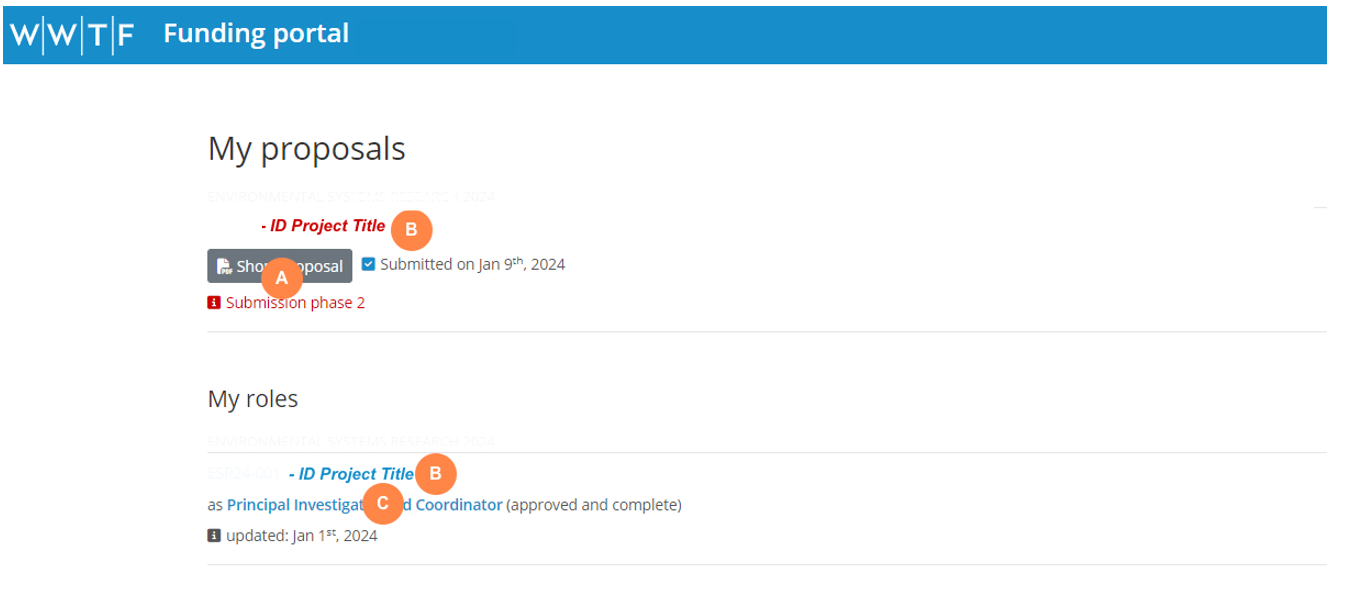
- A Click on “Short Proposal” to download a PDF of your submitted short proposal
- B Click on the project title to edit the full proposal
- C Click on your role to edit your specific role in this proposal
LS26 / Full Proposal / Update information about PIs
Contact details, CV, and information about your role in the project have been automatically transferred from the short proposal to the full proposal. Please ensure the information in the tab "My Profile" and "My Roles" is up-to-date. Only update information if required.
Step 1: Update your profile information if required
Upon login, go to “My Profile” in the top menu to update your profile. To update your CV, delete the previous document and upload a new CV as PDF. The requirements regarding the CV in the full proposal are the same as those in the short proposal . Please review these requirements here.
Step 2: Update information about your specific role in the proposal if relevant
Go to “My Proposal & Roles” in the top menu. Under “My Roles”, click on your role below the title of the proposal.
-
-
You can update the personal information by clicking on “Refresh from profile”. The system will check if there is new information in “My Profile” and update this section accordingly. Should you have uploaded a new CV in "My Profile", it will now be transferred to the full proposal.
-
The requirements regarding the description of your specific role in the full proposal are the same as those in the short proposal. Please review these requirements here.
-
Please note that the information entered here should be specific to the project. If you are participating in multiple proposals that require different subsets of your expertise, please tailor the information according to the project.
LS26 / Full Proposal / Overview of chapters
The full proposal is comprised of six chapters, each under a separate tab:
A chapter with a red alert symbol indicates that it is incomplete. Within the marked chapter, click on the red symbol(s) beside individual sections to highlight the fields requiring attention. A green checkmark symbol indicates that the information in the chapter is complete.
Please note that the symbols might not refresh immediately even if the information in the chapter is complete. Changing to another chapter and going back to the other will refresh the symbol.
LS26 / Full Proposal / Details of chapters
Basic Information
The name, acronym, nominated scientific disciplines, project duration and type of project (regular WWTF Project or Joint Project) can no longer be changed.
- Keywords: These will help the WWTF identify appropriate reviewers for your proposal. Keywords may still be edited or added.
- Suggested peer reviewers: Applicants must suggest five international peers whom they deem qualified to review the proposal. To enable the selection of a balanced set of reviewers, please provide keywords or phrases to describe the reviewers’ fields of expertise. Suggested reviewers must be based outside of Austria and have no conflict of interests with project applicants (complete team and collaborators). Persons with whom the project applicants have worked together (joint publications, research cooperations, etc.) in the last five years will not be considered. Please note that the WWTF will decide if suggested peers will be contacted for reviewing, and WWTF may take different reviewers to those you suggested. As a rule, WWTF will include a maximum of two reviewers suggested by the applicants. The other reviewers are suggested by the jury and/or WWTF office to avoid bias.
- Excluded peer reviewers: Applicants may, without stating any reasons, exclude up to three individuals from reviewing their proposal.
The names of the peer reviewers suggested and excluded by the applicants will be shared with the jury panel but not disclosed to potential reviewers themselves. Each proposal is reviewed by no less than three reviewers.
Personnel and Institutions
The addition, removal, or substitution of core team members (PI&C, co-PIs) are not permitted at this stage. WWTF may make exceptions in well-argued circumstances (e.g., a co-PI moving to an institution abroad or leaving the academic field).
Should well-justified changes in the core team be necessary, please contact WWTF. WWTF reserves the right to exclude projects from further evaluation in cases in which PIs can no longer be part of the project team.
Further partner institutions: Collaborating institutions beyond those of the core team members can be added in this stage. Please note that every person involved in the project must be linked to an institution in order to allow indication of time commitment and salary in the “Budget” section. A signature will be required from the authorizing persons at the core team members’ institutions and at all further partner institutions. A maximum of five different institutions (including those of the core team members) is permitted. Should a project be funded, the addition of further collaborations will be possible.
Project
This is the main section of the proposal that requires elaboration of the project’s scientific content.
Please note that the character limit includes spaces.
Lay summary (max. 1,000 characters)
Please provide a description of your proposed research in English that is suitable for the general public. This will primarily be used by WWTF for communicating your work to non-experts for fundraising and public relations purposes.
Scientific abstract (max. 2,000 characters)
Please provide a concise scientific abstract of the project. This will be used in approaching reviewers. The abstract has been taken automatically from the short proposal, but may be edited for the full proposal.
Work program (max. 15 pages)
Please use the template provided for download in the WWTF Funding Portal.
The main headings in bold below are mandatory. The points beneath each main heading must be addressed, using your own subheadings as you see fit. The numbers of pages are provided as guides. Use a common font type (such as Arial, Source Sans Pro) and font size 11pt. Line spacing should be between 1.3 and 1.5. Do not add any headers or footers (such as page numbers, proposal number, title of proposal), as this information will be added automatically to the file upon upload. Figures, tables, etc. may be included. A final PDF of a maximum of 15 pages, including figures and references, is permitted.
1. Introduction (~2 pages)
- Subject of the research and state of the art, including knowledge gaps and key scientific challenges to be addressed by the project
- Theoretical framework
2. Hypotheses and objectives (~1 page)
- Research questions and/or hypotheses
- Objectives of the project
3. Methodological approach (~6 pages)
- Research plan and methods
- All projects: statistical analysis; sample size justifications (e.g., power calculation if appropriate); inclusion/exclusion criteria; primary/secondary exploratory end points (as applicable); retention/dropout considerations; representativeness or external validity considerations; description of intervention and recruitment process
- Implementation research: please consider implementation frameworks, such as TIDieR, RE-AIM, PRISM, STARI, NASSS, Proctor (as appropriate)
- Interventional trials: please consider SPIRIT guidelines
- Feasibility, risk management and mitigation strategies
WWTF strongly recommends intervention studies to be pre-registered with a registry of your choice from this list. If you choose to pre-register your study before submission of the full proposal, please include the pre-registration number in your application. Note that studies must be pre-registered at the latest before recruitment of first participants.
4. Relevance and innovativeness (~1 page)
- Relevance of the work to prevention research
- Innovativeness of the proposed research
5. Pathway to implementation and impact (~1 page)
- Pathway to health, social and academic impact, including dissemination strategies
6. Project management (~2 pages)
- Justification and roles of personnel, including interdisciplinarity
- Governance structure
- Milestones and deliverables (including Gantt chart)
- Data management, including Open Science aspects
7. Key references
- Please include DOI for each reference
Ethical considerations (max. 800 characters)
If available, the ethical approval (final or preliminary) or confirmation of submission of an ethical approval should be submitted. If an ethical approval for the proposed work has yet not been granted, applicants must provide a timeline and an explanation of the feasibility of obtaining the necessary ethical approvals. In the latter case, applicants commit themselves to obtaining the required permits to commence the project in a timely manner, should it be selected for funding.
Upon selection for funding, submission of the final ethical approvals to WWTF is a prerequisite for the funding contract. As projects must start no later than 6 months after funding approval, grantees must ensure that ethical approvals are submitted to WWTF in time for the funding contract to be concluded.
Regulatory aspects (max. 800 characters)
If your project involves any regulatory aspects (e.g., studies involving drugs and medical devices), please provide a brief description of these regulatory aspects. If these do not apply, please enter “NA”.
Use of generative AI (max. 500 characters)
Please describe if and how GenAI has been used in developing your research proposal. Please see further details here.
Budget
Please note the following guidelines for the budget:
- Maximum 15% difference between the budgets of the short and full proposals is permitted.
- Non-personnel costs should not exceed 40% of the total requested budget.
Personnel costs
- Core team members of the short proposal are automatically listed in the respective table.
- Click “Additional person” to individually add all persons who will work on the project. Please provide their name or select “is N.N.” if the role is to be filled (e.g., PhD candidate, Post Doc). Indicate the affiliation and staff category of each person using the dropdown menu. If an affiliation is not listed, return to the section “Personnel and Institutions” and add the respective institution. Each person must be assigned to an institution.
- Specify if the person will be financed by WWTF or contribute on an in-kind basis, and indicate their yearly time commitment to the project for each year (full time equivalents). A mixture of WWTF and in-kind financing is permitted.
- For persons financed by WWTF, enter the annual salary that corresponds to 100% annual gross costs in the first year of the project (employer and employee costs = gross costs / “Brutto-Brutto-Jahresgehalt”). Please note that PhD positions are often calcuated on a 75% employment basis. The total funding requested for each person will be automatically calculated.
- For personnel costs, an annual 3.5% p.a. increase in salary over the lifetime of the project has been pre-programmed. This is intended to assist with planning only, and actual salaries should be paid according to institutional or collective agreements. Please use baseline salaries according to the date you expect to start the project. (The project should start the latest September 2026.) Please contact your institutional research support services in this matter.
Non-personnel costs
- Add rows to provide a concise overview of all non-personnel costs directly related to the project. Please select the institution and cost category from the dropdown menus. If an affiliation is not listed, return to the section “Personnel and Institutions” and add the respective institution.
- Costs for basic infrastructure (rent, telephone) are not permitted. Costs for larger equipment essential for the project may only be requested on a pro rata basis that also takes into consideration the proportion of time that the equipment will be used for this project.
- WWTF strongly encourages open access publications. Costs for Article Processing Charges (APCs) may be requested.
- Costs for data management purposes (e.g., curation, storage) are eligible.
Budget per region
Cost overview
- Enter the overhead rate for each institution. WWTF permits a maximum of 20% overheads costs. Please consult each institutions’ research services to ensure compliance with all institutions’ internal regulations.
Explanation of Cost Planning (max. 1,500 characters)
- Please provide an explanation of cost planning principles, also indicating access to resources that are already available.
Disclosure of other applications for funding (max. 750 characters)
- If you have applied for funding for this project (or parts thereof) at other organisations, please indicate this here. This will not impact the evaluation of this proposal.
- Double submissions will be reviewed by the FWF. This means that the FWF will receive the list of projects and check whether a similar project has already been submitted to the FWF.
- WWTF does not allow double funding. If your proposal is selected for funding by both WWTF and another funding organisation, we will ask you to decide which funding you will accept.
LS26 / Full Proposal / Signatures
Submission of the full proposal requires the signatures of the authorized persons at all participating institutions ("Authorizations"). This includes the host institutions of the core team members, as well as all further partner institutions.
- Please consult your institutional research services regarding the person mandated to sign the proposals and plan sufficient time to obtain their signatures.
- Make sure that all participating institutions have been added in the “Personnel and Institutions” section before downloading the signatures sheet.
- Enter the name of each authorized person in the online form. This information will be included in the PDF to be signed.
- Download the PDF using the link “You can generate the signature sheet here”.
- Signatures may be provided in various formats
- Add a scanned or physical signature, and upload the form; or
- Insert an electronic signature (e.g., A-Trust, Handysignatur) and upload the form. Please note that electronically signed PDFs cannot be merged into a single document
- The signed signature pages can only be accessed via a link in the final project PDF.
Please ensure signatures are dated. Undated signatures and re-use of signatures from the short proposal will not be accepted.
Unlike in the previous Submission System, signatures from the core team are no longer required in the new Funding Portal.
LS26 / Full Proposal / Proposal submission
Once all symbols in all chapters are marked by green checkmarks, the proposal can be submitted. The “Submit ” button is at the bottom of the “Signatures” chapter.
The PI&C will receive an automatic confirmation email when the Funding Portal receives the completed submission. Please check your emails after clicking the submit button.
If you do not receive a confirmation email, please get in touch with the Call Managers.
You can access your submitted proposal as PDF on the page “My Proposals and Roles”.
No changes are possible after the project has been submitted. After the indicated deadline, submission is no longer possible. Unsubmitted proposals will be excluded from the ensuing evaluation process.
LS25 / Full Proposal / Applicant Response Phase
Applicant Response Phase (10th - 17th of February 2026, 2pm (CET))
The purpose of the applicant response step is to allow the core team to correct any factual errors or conceptual misunderstandings in the external peer reviews. The applicants should respond directly to reviewer comments in a constructive manner.
Scope of applicant response
As much as possible, the applicant response should refer to parts of the full proposal where the reviewer’s concerns are already addressed. Only where necessary and appropriate, should references to peer-reviewed publications in order to correct any factual inaccuracies in the reviews be provided. In addition to providing the DOI, applicants should clearly specify the section (figure, data, text) of the publication that supports their response. Pictures, graphs, or other documents themselves cannot be inserted or attached.
- The applicant response must not be regarded as an opportunity to extend the full proposal. Elaboration upon aspects of the full proposal with more detail is not permitted.
- New information, including new research results and methods, should not be provided.
- Applicant responses should not include references to any new awards, appointments, or publications that may have occurred since the submission of the full proposal.
- Response should be clearly presented, objective and concise. The limit of 3,000 characters (with spaces) applies for all teams. Thus, only include information that clearly addresses the points of the reviewer.
Both the scientific workplan and CVs are assessed as at the time of the full proposal submission, and therefore no updates should be provided. Such additional information will not be considered by the jury members.
Process for applicants
- All steps of the applicant response phase will proceed over the WWTF Funding Portal.
- Applicants will be given 7 calendar days to respond to the peer reviews (10th - 17th February 2026, 2pm (CET)).
- All core team members will receive an email notification from the Funding Portal when the applicant response phase is open. Core team members are therefore strongly advised to regularly check their provided email address during the indicative time period.
- All core team members will have access to the anonymized reviews for their proposal and have the opportunity to edit the response.
Only the PI&C can submit the final applicant response.
What will happen to the applicant response?
- The applicants' response will be provided to the panel after the panel has received all external reviews and prior to the panel meeting to determine funding.
- Applicants' responses will not be viewed by the external reviewers.
- The jury panel will be briefed about the scope of permitted responses and informed to ignore responses that fail to observe these guidelines. Panel members will consider how well applicants have addressed any concerns raised by the reviewers and will consider additional valid evidence provided within the response.
- Please note that, depending on its content and quality, the applicant response can potentially have positive and/or negative effects on the evaluation of the proposal by the jury panel.
Submission of a response to reviews is not compulsory. However, the jury panel will be informed that all teams were provided with the opportunity to respond to reviews.
LS26 Targeted Prevention / WWTF Contacts
WWTF aims to assist you in all matters regarding the submission process. If you do not find answers to your questions on these pages, please do not hesitate to contact us.
You can usually reach us during regular office hours.
Grace Liu | grace.liu@wwtf.at | Tel.: +43 1 402 31 43 12
Benjamin Missbach | benjamin.missbach@wwtf.at | Tel.: +43 1 402 31 43 19