Vienna Research Groups Call 2027
- VRG27 / Key Facts
- VRG27 / Call Specifications
- VRG27 / About the Vienna Research Groups for Young Investigators Program
- VRG27 / Scope of the call
- VRG27 / Submission process and deadline
- VRG27 / Eligibility of applicants and roles in the project
- VRG27 / Career perspectives and funding phases
- VRG27 / Interim evaluation
- VRG27 / Funding and evaluation criteria
- VRG27 / Eligible costs
- VRG27 / Gender aspects
- VRG27 / Good scientific practice and ethics
- VRG27 / Open Science
- VRG27 / Use of generative AI
- VRG27 / Selection and decision process
- VRG27 / Employment and funding contract
- VRG27 / Monitoring and reporting
- VRG27 / Public relations and Community activities
- VRG27 / Submission Guideline
- VRG27 / Essential information
- VRG27 / Register & Login
- VRG27 / Create a new proposal
- VRG27 / Information about VRG candidate and proponent
- VRG27 / Overview of chapters
- VRG27 / Details of chapters
- VRG27 / Proposal submission
- VRG27 / Contact
VRG27 / Key Facts
Scope
This call is issued within the WWTF Vienna Research Groups for Young Investigators programme, in the area of Information and Communication Technology, under the theme “AI/ML for Vienna”. The focus is on two parallel tracks:
- “Foundational AI/ML Research” track: candidates who advance the theoretical or methodological foundations of AI/ML in their own right
- “Advancing discipline(s) with AI/ML” track: candidates from any other discipline (e.g. life sciences, physics, environmental sciences, social sciences and humanities…) who develop or advance AI/ML concepts or methods to address open questions in their own field.
In both cases, the proposed work of the future research group is expected to make genuine methodological contributions to AI/ML or to the respective discipline via the development or advancement of AI/ML tools and concepts, rather than merely applying existing tools, and to demonstrate the ambition to advance the state of the art. Engagement with Vienna's broader AI/ML research community is encouraged.
Applicants will be asked to select their evaluation track. Positions are allocated separately to each track, and applications are evaluated and ranked only against other applications within the same track. Please note that "For Vienna" in the call title refers to the location of the future research group, the topics chosen to be researched do not have to be specifically based on the Vienna region.
Who can apply?
VRG candidates are researchers in their post-doc phase, who apply together with an established scientist from a Viennese university or research institution.
- Researchers who can apply for this call are up to eight years after PhD, counting backwards from the submission deadline of this call. Care duties may extend this period by up to four years.
- At the time of application, VRG candidates must be based at home institutions outside of Austria. Specifically, this means the VRG candidate (i) must not have an employment contract with an Austrian institution in the timeframe between three months before the submission deadline to the submission deadline, and (ii) must have been employed at a foreign research institution for at least two years in the last three years before the submission deadline.
Project duration
A Vienna Research Group typically runs 6-8 years.
Funding
There are € 7.2 million reserved for this call. The max. budget per research group is € 1.8 million, up to four research groups can be funded.
Timeline
- Submission deadline: 2 March 2027, 14:00 CET
- Review phase 1 decision: mid of April 2027
- Review phase 2 decision: end of July 2027
- Hearings: September 2027 (exact dates tbd, candidates will participate online)
Process
- Submission of a full proposal until the deadline stated above via the WWTF Funding Portal (submission possible starting November).
- In case you are invited for participation in the hearing, the participation is mandatory to be considered for funding.
Information session
- 21 January 2027, 2pm-4pm CET online via this zoom link
VRG27 / Call Specifications
VRG27 / About the Vienna Research Groups for Young Investigators Program
As the aim of the VRG program is to strengthen Vienna as a research location by attracting talents who will provide new expertise and input for the Viennese research landscape, VRG leaders must be recruited from an institution outside of Austria. VRG leaders are independent in designing their research work and recruiting staff. Over the years, they are expected to attract additional and increasing third-party funding.
VRG27 / Scope of the call
This call is issued within the WWTF Vienna Research Groups for Young Investigators programme, in the area of Information and Communication Technology, under the theme “AI/ML for Vienna”. The focus is on two parallel tracks:
- “Foundational AI/ML Research” track: candidates who advance the theoretical or methodological foundations of AI/ML in their own right
- “Advancing discipline(s) with AI/ML” track: candidates from any other discipline (e.g. life sciences, physics, environmental sciences, social sciences and humanities…) who develop or advance AI/ML concepts or methods to address open questions in their own field.
In both cases, the proposed work of the future research group is expected to make genuine methodological contributions to AI/ML or to the respective discipline via the development or advancement of AI/ML tools and concepts, rather than merely applying existing tools, and to demonstrate the ambition to advance the state of the art. Engagement with Vienna's broader AI/ML research community is encouraged.
Applicants will be asked to select their evaluation track. Positions are allocated separately to each track, and applications are evaluated and ranked only against other applications within the same track. Please note that "For Vienna" in the call title refers to the location of the future research group, the topics chosen to be researched do not have to be specifically based on the Vienna region.
VRG27 / Submission process and deadline
The application process for the Vienna Research Groups program includes the following steps:
- Submission of a proposal: concise proposal demonstrating the candidate’s qualifications and proposed research
- Participation in a hearing: presentation of proposed research and Q&A with jury (online participation by the VRG candidate)
Proposal Deadline: 2 March 2027, 14:00 CET
Hearings: September 2027, date will be communicated as soon as possible (check WWTF website and funding portal for updates regularly)
Important information for the submission of your proposal
- Applications must be submitted via the WWTF Funding Portal at https://fundingportal.wwtf.at/ by the deadline stated above.
- The structure and content of the application are described in more detail in the Submission Guideline.
- Important: The application process requires the signature of an authorised person from the future host institution ("authorization"). Please contact the host institution you're applying with to find out about their internal processes and timelines.
- We recommend registering and creating a proposal to find out what the requirements are, even if you are not yet sure whether you want to submit one. Any proposals that are not submitted will be deleted shortly after the deadline for the call.
- The application must be written in English.
- Please check with the host institutions for information on any pre-selection deadlines.
Applications must be submitted via the online Funding Portal by the deadline indicated in the Call Specifications. Submissions after the deadline will not be considered.
VRG27 / Eligibility of applicants and roles in the project
The general eligibility of applicants is specified in the / WWTF Funding Guideline (in German only).
An application is prepared in tandem: the future VRG leader ("VRG candidate") applies together with the proponent, who represents a research institution in Vienna.
Role & responsibilities of the proponent:
- The proponent is an established scientist based at a university or non-profit non-university research institution (public or private) in Vienna (“host institution”) that intends to hire an excellent young researcher from abroad.
- The host institution is responsible for the selection of the VRG candidate, as well as for providing a well-defined career path for the candidate.
- Active recruitment procedures are mandatory. The search for the VRG candidate is carried out by the host institution. International publication of the job advertisement – e.g., in a high impact journal that is relevant for the topic and/or via professional societies/mailing lists – is compulsory. For promotional purposes, the host institution may provide the link / a digital copy of the job advertisement to the WWTF, for publication on the WWTF website.
- The proponent is responsible for the coordination of the application at the host institution and supporting the VRG candidate at every stage of the application. In case of funding, the proponent is also responsible for the integration of the candidate in the host institution.
- Proponents can apply with max. two VRG candidates.
Role of the VRG candidate & eligibility criteria:
VRG candidates are early career researchers, generally postdocs, who seek to advance their research career by establishing an independent research group and assuming leadership responsibility for several group members.
As the aim of the VRG program is to strengthen Vienna as a research location by attracting talents who will provide new expertise and input for the Viennese research landscape, VRG leaders must be recruited from an institution outside of Austria. VRG leaders are independent in designing their research work and recruiting staff. Over the years, they are expected to attract additional and increasing third-party funding.
- Researchers who can apply for this call are up to eight years after PhD, counting backwards from the submission deadline of this call (this year, the cut-off date is March 2 2019). Care duties and/or sickness may extend this period by up to four years, please find information on the extension grounds below.
- At the time of application, VRG candidates must be based at home institutions outside of Austria. This means the VRG candidate
- (i) must not have an employment contract with an Austrian institution in the timeframe between three months before the submission deadline to the submission deadline, and
- (ii) must have been employed at a foreign research institution for at least two years in the last three years before the submission deadline.
- WWTF also welcomes applicants with Austrian citizenship who wish to return to Austria.
- Please note that the aim of the VRG program is to bring new competences to Vienna.
- The VRG candidate can only be involved in one proposal.
WWTF encourages Vienna-based research institutions to actively search for female candidates.
In the case of successful appointment of a woman, the Vienna host institution may apply for additional financial measures ("Gender Mainstreaming Bonus") from the WWTF to support their gender mainstreaming activities. Costs for childcare and / or career coaching for female WWTF-funded personnel may be covered, please find more information in the eligible costs section of the Call Specifications.
WWTF offers a Dual Career Service Support for partners of VRG leaders.
In case of funding, please contact WWTF with regards to dual career service support.
Provisions regarding the extension of the eligibility period of VRG candidates.
WWTF takes into consideration career breaks due to care duties and/or sickness. The maximum prolongation period is 4 years (48 months). Please contact WWTF before submitting your proposal if you have doubts regarding your eligibility. Prior to contacting WWTF, please read and fill out this document.
In case of changes with regards to your affiliation after you have submitted the proposal to WWTF, inform WWTF about the changes via e-mail to the call managers.
Non-university institutions as host institutions of VRG leaders
In the case of non-university institutions as host institutions, academic links to a university partner must be demonstrated in the application (for example, in the form of a signed letter of intent by the university partner), to ensure integration into an academic teaching environment in Vienna. This is to enhance the prospects of a potential future at a university in Vienna.
The following points have to be addressed in the corresponding sections of the proposal:
- Guarantee of scientific independence of the VRG leader and guaranteed establishment of own research group of the VRG leader at the host institution.
- Permanence of the career track: permanent position at the latest after successful interim evaluation.
- Independent supervision of Master students and PhD candidates.
- Teaching opportunities.
Additional partners:
- Additional research partners may also be involved in and contribute to the work of the VRG group. If these partners contribute substantially to the VRG project, they are eligible to receive funding from the VRG project. They also may provide resources and funding for the project as in-kind contributions.
- No industry involvement is required. Industry partners are not eligible for funding. However, they might participate in the project with in-kind contributions, both through financial or further resources.
- Partners may be affiliated to institutions in or outside Vienna (including international partners). Partners inside and outside Vienna are optional and not a requirement for application.
- Partners outside of Vienna may receive up to 20% of the total requested funding.
“Home institution” refers to the VRG candidate’s institution at the time of application, i.e., the institution outside of Austria to which they are currently affiliated.
“Host institution” refers to the VRG candidate’s future host institution in Vienna, i.e., the institution where they plan to start their research group.
VRG27 / Career perspectives and funding phases
The VRG program emphasizes that the contractual arrangement and institutional position of the VRG group leader should be structured to support a clear long-term career trajectory, with the ultimate aim of securing a tenured appointment at the host institution in Vienna.
The path towards a tenured position (or an equivalent career path) must be specified in the proposal. WWTF expects a qualification agreement (“Qualifizierungsvereinbarung”) to be signed within three months after the start of the project. See next chapter "Interim evaluation" for more information.
It is important that the prospective host institution in Vienna provides a well-defined career plan for the candidate, including allowing for independent supervision of PhD candidates upon commencement of the contract. The details stated in the proposal will be the basis of the contract in the case of funding.
The funding period of the Vienna Research Group is between six to eight years and has two phases.
- The first phase is the phase before the career step / interim evaluation of the VRG candidate.
- The second phase is the phase after the VRG candidate's career step, e.g. after the positive interim evaluation. In case of a negative result of the interim evaluation, the funding of the group will be discontinued after a "phasing out" period (max. 1 year).
VRG27 / Interim evaluation
One of the main objectives of the VRG programme is to enable recipients to pursue a career path that leads to a full professorship. In Austria, this typically occurs via a career position, in accordance with UG2002 (for organizations that fall under the UG2022). The VRG programme itself, however, does not extend to the full professorship, since this requires either an open external appointment procedure or an internal call for applications for a certain number of dedicated positions.
Therefore, VRG leaders are expected to advance to Associate Professorship within the duration of the Vienna Research Group. Upon starting work at the host institution, VRG leaders are offered a qualification agreement („Qualifizierungsvereinbarung“, „QV“). Depending on the institution, this either happens immediately upon commencement at the university, or after a few months (WWTF asks for a maximum of 3 months between commencement of the project and provision and signing of the QV). Once a QV has been signed, the VRG leader is listed as an „assistant professors“. These positions are temporary.
In the QV, the criteria for promotion to associate professorship are defined. After a certain period of time (depending on the institution and the individual agreement between host institution and VRG leader), usually 2-4 years, an interim evaluation of the VRG leader's performance is carried out at the host institution.
From WWTF's perspective, there are different scenarios for the interim evaluation:
Scenario 1: Evaluation of the QV involving external experts
WWTF wishes to be involved in this process, as stipulated in the contract. This is typically done by WWTF appointing an external reviewer. As soon as the QV review process is initiated, the host institution approaches WWTF regarding the nomination of a reviewer.
Scenario 2: Evaluation of the QV with predominantly formal internal assessment.
If the university's evaluation process does not include external reviews, WWTF will conduct its own, moderate, evaluation after 3-4 years runtime of the project. WWTF's evaluation can take place at a later date than the QV evaluation by the host institution.
Scenario 3: Interim evaluation by the WWTF without a QV agreement.
If there is no QV agreement (e.g. if the VRG leader starts as associate professor or higher), WWTF will conduct its own, moderate, evaluation after approximately three to four years.
The evaluation step usually takes place between year 2-4 of a VRG grant. Earlier dates are possible. In case of a negative result in the interim evaluation, the funding of the group will be discontinued after a “phasing out” period (max. 1 year).
VRG27 / Funding and evaluation criteria
The following criteria are used throughout the evaluation process:
Scope
- Is the project within the scope of the call as described in the call specifications? Projects which are not within the call's scope will be immediately rejected by the jury, regardless of the scientific quality.
The key criterion in the evaluation of applications is scientific quality. This means both the submitted project and the candidate must be scientifically outstanding. This will be assessed using the following criteria:
Quality of the VRG candidate
- Scientific excellence and academic potential of the applicant: Accomplishments and potential of the applicants to conduct the proposed research and to go beyond the state of the art. Candidates should have substantial research experience and research outputs. This should be demonstrated through a record of high-quality publications (in peer reviewed journals) and comparable achievements. Academic achievements will be evaluated in accordance with academic age.
- Independent thinking and leadership: Demonstration of the VRG candidate’s leadership potential and capacity to conduct independent research.
Quality of the proposed research
- Innovative character of the proposed research: Does the proposed research work meet the highest relevant international quality standards? Does the project show scientific originality and innovative aspects? Are the methods and research approaches appropriate and innovative?
- Feasibility: Is the timeframe sufficient for carrying out the project? Are the proposed resources suitable to achieve the goals? Is the budget adequate?
- Consideration of gender aspects: has the relevance of potential sex-specific and gender-related aspects of the proposed project been considered and explained throughout the proposal?
- Relevance: What is the project’s mid-to long term academic, societal and economics impacts, particularly with regard to Vienna?
Fit to the research environment at the new host institution:
- Integration into the research environment: Plans and commitments for the integration of the VRG candidate into the research environment of the host institution have to be described in the proposal. This includes a formal position in the university structure, integration into academic teaching, and authorisation to supervise master and doctoral students from the commencement of their contract.
- If a non-university research institution applies for funding, the points listed here are considered important funding and evaluation criteria.
- Career perspective: A career model within the university, which offers the VRG candidate a long-term career perspective linked to evaluation of individual performance.
- Continuation of funding / evaluation: Concept for the interim evaluation involving WWTF.
Other aspects:
- Career breaks such as for parental leave, care duties and longer illnesses will be taken into account in the evaluation of the proposals. Please indicate the time periods to allow them to be considered.
- Consideration of WWTF’s Gender Strategy and Equality Plan is mandatory.
Please note that the project cannot be subject to double funding. WWTF reserve its rights to check for double funding with other funding organizations.
VRG27 / Eligible costs
Funding should be used to cover the costs for the research group. All costs that are directly attributable to the project and are regarded as commonly required in the respective scientific field are eligible for funding. Please also consider your host institution’s internal guidelines for eligible expenses/costs.
Personnel costs
- WWTF is dedicated to funding researchers. Hence, the larger share of the project’s budget should be allocated to personnel costs for researchers working on the project.
- Eligible forms of employment contracts are full-time and part-time contracts as well as marginal employments (“Arbeitsvertrag”). Contracts for services (“Werkvertrag”) are only permitted if the nature of the work means that it cannot be performed through employment contracts. In general, it is assumed that the funding of individuals will be predominantly through employment contracts at the participating institutions and not through other types of employment.
- All persons employed through a WWTF-funded project should receive a fair employment contract with at least a minimum wage according to the “Kollektivvertrag” (collective agreement) of the Austrian Universities / non-university research institutions or – for staff employed at institutions with no collective agreement – according to the standards of the Austrian Science Fund (FWF, wage scheme available online,"FWF Personalkostensätze").
- Salaries higher than those stipulated in the collective agreement are possible, subject to the agreement of the host institution and justification based on the experience of the group leader and the researchers.
- Applications for personnel costs must be in one of the following categories:
- PI/Group leader
- Senior Personnel: highly qualified scientists, usually permanently employed
- Post Doc: or equivalent qualification, including senior postdocs
- PhD Candidate: or equivalent qualification level
- MA/BA Student: Bachelor or Master students
- Technician or equivalent (proportional funding only)
- Data Manager/Steward (proportional funding only)
- Student Assistant
- Administrative Personnel (proportional funding only)
Non-personnel costs
- Non-personnel costs should not exceed 30% of the overall budget. If non-personnel costs exceed 30% of the total budget, a justification must be included in the budget. Costs may incur in the following categories:
- Equipment: Smaller equipment can be purchased within the scope of the grant. This includes devices up to € 1,500 each as well as software specific to the projects. General office software is not eligible for funding. Funding by WWTF under this scheme is not intended to cover investment in general and larger infrastructure, however pro rata depreciation rates over the project duration for equipment necessary to the project may be funded.
- Consumables: Costs for project-related expenses, such as consumables. WWTF does not fund consumables that are general and not project-specific (e.g., paper, printer toner).
- Travelling: Costs for travel and accommodation for scientific meetings and conferences, field work, expeditions may be funded. Please also consider the regulations of your host in-stitution for travel costs.
- Publication costs: Costs incurred for publication activities, such as printing costs, article processing charges (for open access), data management, etc. This also includes costs for archiving research data in open repositories. Please also consult WWTF’s Open Science Policy.
- Data management: Costs for data access can be covered. The grant also covers costs in-curred for data preparation in order to make the data accessible via a repository.
- Workshops and conferences: Costs for organizing events, workshops, and conferences are eligible.
- Other:
- further third-party costs (e.g., external collaboration, consulting, studies, software development), as well as
- costs for childcare needs resulting from project-related activities not covered through regular childcare (up to € 1,000),
- career coaching for female WWTF-funded personnel up to € 5,000, maximum € 3,000 per person,
- leadership education and training for VRG leader up to € 10,000,
- relocation of the VRG leader up to € 5,000 (e.g. costs for moving furniture, costs for searching new apartment, cost of giving up old apartment. Not covered: costs related to furnishing the new apartment and renovation work in the new apartment).
Running costs for basic infrastructure (telephone costs, rents) as well as costs for the acquisition of infrastructure and basic equipment are not eligible for funding as these should fall under the category of overhead costs.
Indirect costs (overheads)
Please note, WWTF offers a maximum of 20% overhead lump sum to compensate for all indirect/administration costs. Overhead is calculated as 20% of the direct costs of the project. This means that flat fees for payroll or project accounting charged to the project accounts are non-eligible direct costs. The total funding volume is calculated as direct plus indirect costs. Please consult the WWTF Reporting and Accounting Guideline for further information.
Applicants are required to comply with the overhead regulations of the involved institutions.
In-kind contributions
In-kind contributions from the host institution should amount to at least 20% of the total project budget. These in-kind contributions must be described in detail. Generally, it should include the salary of the VRG leader after a positive interim evaluation.
Basic infrastructure (e.g., office premises, telephone, internet, laboratory space etc.) do not count as in-kind contributions. As these are not specific to the project, they should be covered by overheads. Other in-kind contributions may be in the form of in-kind involvement of project staff, consumables/software or monetary contributions.
Further information about costs recognised by WWTF can be found here.
VRG27 / Gender aspects
WWTF’s Gender Strategy and Gender Equality Plan must be considered throughout the application (for applicants, pages 19 and 20 of the document are especially relevant). Please note, that WWTF requests jury members and reviewers to take into account both gender in research team composition, as well as gender in research content during evaluation processes.
The following questions should be considered:
Equal opportunities in research
- Please take into consideration gender balance/equality in the research group at all levels, including in decision-making positions, e.g., what steps have been taken to approach / achieve it?
- Do working conditions allow all members of staff to combine work and family life in a satisfactory manner?
- Are there mechanisms in place to manage and monitor gender equality aspects, e.g., workforce statistics?
Gender in research content and in the research ideas phase
- If the research involves humans as research objects, has the relevance of gender to the research topic been analysed?
- If the research does not directly involve humans, have potentially differentiated relations of men and women to the research subject (e.g., relevance, impact of findings) been sufficiently considered?
- Have literature and other sources relating to gender differences in the research field been consulted?
Proposal phase
- Does the methodology ensure that (possible) gender differences will be investigated: that sex/ gender differentiated data will be collected and analysed throughout the research cycle and will be part of the final publication?
- Does the proposal explicitly and comprehensively explain how gender issues will be handled?
- If there are no identifiable gender aspects after a detailed review by the applicants, this must be justified, e.g., by providing reasons to demonstrate that no sex, gender, and other relevant differences have been found.
Research phase
- If there are further aspects of the project in which sex/gender could be a factor (e.g., samples, testing groups), are these gender-balanced?
- Are questionnaires, surveys, focus groups, etc. designed to unravel potentially relevant sex and/or gender differences in your data?
- Is data analysed according to the sex variable? Are other relevant variables analysed with respect to sex?
VRG27 / Good scientific practice and ethics
Compliance with the rules for good scientific practice, including the observance of ethical aspects in research, is mandatory. This pertains to the application process and, in case of funding, the actual research work.
- WWTF is member of the Austrian Agency for Research Integrity (OeAWI) and thus committed to their standards for good scientific practice. Hence, applicants must comply to OeAWI standards.
- In case of suspected scientific misconduct WWTF will employ the ombudsperson at the applicant’s institution or request OeAWI to investigate the case.
- Based on the outcome of investigations by the ombudsperson or OeAWI, WWTF reserves the right to exclude the applicants and the application from the involved and future calls.
Research may include ethical aspects that require the approval from an ethics committee/institutional review board.
- If the candidate states, that approval from the ethics committee/institutional review board is required for the planned project, the approval (“Votum”) must be submitted to WWTF in due time. The process of obtaining ethical approval shall start right after the VRG candidate has started their position at the new host institution in Vienna.
- The approval by the ethics committee should be specific for the planned WWTF project; therefore, the title of the project should be the same as on the approval (minor deviations are possible). If the title of the approved research differs significantly from the proposed project, a statement must be provided (in the online Funding Portal), confirming that the approval will cover the planned research.
- If the main applicant for the ethical approval is not the VRG leader, a clear statement must be included in the proposal, in which the VRG leader confirms that he/she is authorized to conduct the planned research within this ethical approval.
- If the planned research is covered by an existing approval, the applicants must submit the extension of the approval (“Verlängerung der Gültigkeit des Votums”). The above also applies for extensions.
VRG27 / Open Science
WWTF requires compliance with its Open Science Policy. This document outlines the rights, roles and responsibilities of WWTF, researchers, and research organizations.
VRG27 / Use of generative AI
WWTF emphasizes the importance of human responsibility for the content submitted at all stages of the application process. Furthermore, WWTF recognizes that the use of genAI tools is pervasive and can facilitate proposal writing, for example in relation to improving written language. However, substantial use of genAI must be declared as such for the sake of transparency.
“Substantial use” is defined in line with the European Commission’s definition: “[…] using generative AI as a basic author support tool is not a substantial use. However, interpreting data analysis, carrying out a literature review, identifying research gaps, formulating research aims, developing hypotheses, etc. could have a substantial impact.” (EC 2026: Living Guidelines on the responsible use of generative AI in research. Fourth Version, October 2026)
This mainly concerns critical parts of scientific relevance, such as hypothesis formulation and the scientific project plan. Applicants will be required to provide statements on the use of generative AIs at both the short and full proposal stages. WWTF emphasizes the importance of human responsibility for the content submitted at all stages of the application process. Images depicting real-world scenarios produced by generative AI must be declared.
In review and evaluation processes WWTF does not allow AI to be used for the actual formation of judgments and decision-making.
VRG27 / Selection and decision process
Call jury
- The core element of WWTF’s decision making processes is an international jury mandated to provide a funding recommendation to the WWTF boards.
- Depending on the scope of the call, the jury is comprised of 5-8 outstanding international experts who have no current affiliation to an Austrian institution.
- Jury members are selected by WWTF prior to the submission deadline according to their expertise with regard to the call topic, and after a conflict-of-interest check. For details on the conflict of interest check, see section on reviewers below.
- Members of the jury will be published after the WWTF Board of Directors’ formal funding decision.
- Please note that WWTF does not allow for rebuttals to recommendations by the jury panel or decisions by the WWTF Board of Directors.
Formal eligibility check by WWTF
- WWTF office conducts a formal eligibility check of the proposal based on the criteria outlined in the WWTF Funding Guideline and in this document.
- Substantial deficiencies and missing items in the application will lead to the exclusion of the funding application from further evaluation and rejection on formal grounds. The strict timeline of the call does not allow for proposals to be sent back to the applicants for improvements and supplementing documents.
Evaluation step I: Preparatory meeting 1
- Each proposal is independently assessed by at least two jury members based on the evaluation criteria.
- The jury decides if a proposal should be reviewed or rejected. This usually takes place 1 month after the submission deadline.
- Proposals that are not in the thematic focus of the call and/or that do not meet international scientific quality standards and/or that are not competitive within the applicant cohort will be rejected at this stage and will not be considered for the review process.
- All applicants will be promptly informed about the decision. Rejected applicants will be provided with a short jury statement explaining the decision. Successful applicants will be informed that they have been admitted to the next stage.
- After the preparatory meeting, additional members may be added to the jury if additional expertise is required to cover the topics of the proposals.
Evaluation of proposals / Review process
The proposals admitted to the next stage of the evaluation process will undergo a review process.
- WWTF will obtain a minimum of two (usually 3-4) written reviews for each proposal.
- Reviewers are recognized international experts in the topic(s) of the proposals. WWTF does not consider reviewers with an Austrian affiliation. WWTF aims for diversity in the cohort of reviewers (gender, age, countries).
- All reviewers are checked for potential conflicts of interests with the applicants by WWTF. As a rule, reviewers should not have close professional relations with the applicants. Practically, this excludes reviewers that have published with the applicants within the last five years or have had a collaboration in a research project in this timeframe. In case of very close cooperation with the applicants over a longer period of time, the reviewer will not be contacted. Joint publications in edited volumes / proceedings, “community papers” with more than 30 authors or common attendances in workshops and conferences do not qualify as conflict of interest. Additionally, reviewers are asked to disclose any potential conflict of interest.
- Reviewers will provide their assessment via a standardised questionnaire in the WWTF Funding Portal.
- The expert reviewers remain anonymous to the applicants.
- In the proposal submissions, applicants are asked to suggest 5 experts, whom they deem qualified to review the proposal. WWTF will check the reviewers for potential conflict of interests. WWTF is free to choose / not to choose any of the suggested experts. Jury members also nominate reviewers.
- Applicants may also exclude up to 3 persons without stating any reasons. Reviewers on the negative list will not be contacted.
Evaluation step II: Preparatory meeting 2
- The jury decides which VRG candidates are invited to the hearing.
- Each proposal is again independently assessed by at least two jury members based on the evaluation criteria and taking into consideration the written reviews.
- This usually takes place 1-2 months before the hearings.
- All applicants will be promptly informed about the decision. Rejected applicants will be provided with a short jury statement explaining the decision and the anonymized reviews. Successful applicants will be informed that they are invited to the hearing. Invited applicants will receive the anonymized reviews after the formal funding decision by WWTF boards.
Evaluation step III: Hearings and jury meeting
- At least two jury members are assigned to each proposal and act as rapporteurs for the proposals.
- The basis for the evaluation by the jury are the proposal, the candidate’s performance at the hearing, as well as the reviews.
- The VRG candidate’s attendance at the hearing is mandatory in order to be considered for funding. Candidates will participate online in the hearing.
- The result of the jury meeting and hearings is a funding recommendation by the jury for each application: “to be funded” or “not to be funded” or “reserve candidate”.
- Reserve candidates are ranked by the jury. In case contracting with candidates who were initially nominated for funding is not successful, the reserve candidates will be contacted by WWTF, following the order proposed by the jury.
Formal funding decision
The jury recommendation will be formally confirmed first by the WWTF Advisory Board and then approved by the WWTF Board of Directors.
- Applicants will be promptly informed about the decision.
- The decision may include budget cuts as well as additional conditions and recommendations.
- Applicants will receive anonymized full text reviews. Unsuccessful applicants will also receive a short statement by the jury explaining the main reasons why the application was not selected for funding.
VRG27 / Employment and funding contract
In case of funding, WWTF will contact the VRG candidate and proponent for the steps leading to a funding contract.
The VRG leader will be provided with the necessary documents for the contract.
A signed employment contract between the VRG leader and the host institution (“Dienstvertrag”) must be sent to WWTF no later than two months after the formal funding decision has been made by the WWTF Board of Directors. Otherwise, the reserve candidates will be contacted to begin the contracting process.
- Only upon finalisation of the funding contract with WWTF will the name of the successful candidate(s) be published.
- Projects may start immediately but should start not later than 18 months after the formal funding decision by the WWTF Board of Directors.
- The formal funding contract will be signed between WWTF and the host institution of the VRG leader (for universities according to §27 of the Universities Act 2002). The contract provides the VRG leader with the scientific responsibility and financial authority for conducting the project.
VRG27 / Monitoring and reporting
Funded VRG leaders are committed to delivering reports and participating in evaluation and monitoring. WWTF offers the possibility to adapt the work plan according to project needs. For details see WWTF’s Reporting and Accounting Guideline.
VRG27 / Public relations and Community activities
Funded projects will be showcased via WWTF public relations activities. This includes displaying the projects via respective websites, contributing to other multimedia activities or presenting the work at stakeholder meetings. Funded projects will also be invited to particpate in community actitivies.
VRG27 / Submission Guideline
VRG27 / Essential information
All proposals must be written in English and must be submitted electronically via the WWTF’s Funding Portal.
- The Funding Portal allows you to manage your personal information independently of proposals and calls. If you are involved in multiple proposals or apply in a future call, you can draw upon this saved personal information in the section "My profile".
- The VRG leader has to invite the proponent to the proposal. Please note that only the VRG leader can submit the proposal.
- A chapter with a red alert symbol (
 ) indicates that it is incomplete. Within the marked chapter, click on the red symbol(s) beside individual sections to highlight the fields requiring attention. A green checkmark symbol (
 ) indicates that the information in the chapter is complete.
- Note: The Funding Portal will save your entries and changes automatically. You can pause data entry at any time. All information will be available again upon your next login. The system constantly validates and saves data in background. Please refresh the website when you think your entries have not been accepted. This will fix the problems.
Note: The funding portal closes at 2 pm CET on the day of the deadline. The maximum total size limit of the proposal is 5 MB.
Please note that only the VRG candidate can submit the proposal.
VRG27 / Register & Login
Register at WWTFs’ Funding Portal
- Go to https://fundingportal.wwtf.at/
- Go to “Register” in the top menu
- Enter your registration data (* indicates mandatory fields)
- You will receive an e-mail to confirm your registration
To log-in with an existing account: go to https://fundingportal.wwtf.at/ and enter your credentials.
VRG27 / Create a new proposal
Create a new proposal
- Go to “Calls” in the top menu
- Select the respective call
- Click “Create new proposal” and new proposal will be created
- Once created, you will find all your proposals under “My Proposals & Roles” in the top menu. You can delete proposals at any time. Proposals that are not submitted will be deleted automatically after the submission deadline.
VRG27 / Information about VRG candidate and proponent
In the proposal, WWTF requires information about the Vienna Research Group Leader and the proponent. Further partners can be part of the project (either in-kind or funded by WWTF) and can be added later on. First of all, you have to complete your profile. The VRG candidate should create the proposal and invite the proponent to the proposal.
Step 1: Complete "My Profile":
Upon login, you can fill out your profile or update it (if you have an existing user profile) in the top menu “MY PROFILE”.
- Please go to the tab in the right top corner and enter your personal data under "My Profile".
- Please upload your CV based on the template provided for your respective call ("wwtf_cvtemplate_vrg.docx")
- The CV has two parts: the Curriculum Vitae (around 1 page) and a list of your publications (around 1 page). Please do not exceed this page limit as the system will not accept documents longer than 2 pages.
- Please list all items in reverse chronological order.
- Publications: please provide a narrative description of your research output, i.e., what’s your focus in publications (e.g., aiming for journals or aiming for monographs); how do you deal with data in your research output; do you aim for knowledge transfer to the public, politics or industry or do you focus on an academic audience, etc.?
- Please also provide the top 10 selected publications including DOI and a link to a more detailed list of your publications. This can either be your institutional website, personal website, an ORCID profile or a Google Scholar profile.
- Also include a short narrative description of your additional skills and experience. Please insert your current primary affiliation („home institution“). In case you have multiple affiliations (e.g., using different affiliations for different proposals), these also can be added.
Note: The “home institution” is the current institution of the VRG candidate at time of the application (i.e. abroad). The “host institution” is the future Viennese institution.
Step 2: Confirm your role as VRG candidate
- Go to your proposal under the tab "My proposals & roles" and select your proposal.
- Go the tab "VRG Leader & Proponent" in the proposal and click "I am the VRG Leader".
- Invite the proponent to the proposal by adding their name and e-mail adress. The proponent is the scientist at the Vienna host institution responsible for the coordination of the proposal and will support the applicant at every stage of the application. He*she is also responsible for the integration of the applicant in case of funding.
Invite the proponent early on, as the funding portal needs the information to create the budget template. He*she has to perform the same steps as the VRG candidate (fill out "my profile" and update section "my role"), to be able to submit the proposal.
Step 3: Update the section "My role"
The system will ask you to update "my role".
- Click "refresh from profile". The system takes the recent information added to your profile, including the CV.
- Add missing information
- Staff category.
- Confirmation of eligibility.
- Add your current home institution (= institution you are currently performing your research at).
- Sign the "Affirmation". The affirmation serves as your signature to the proposal.
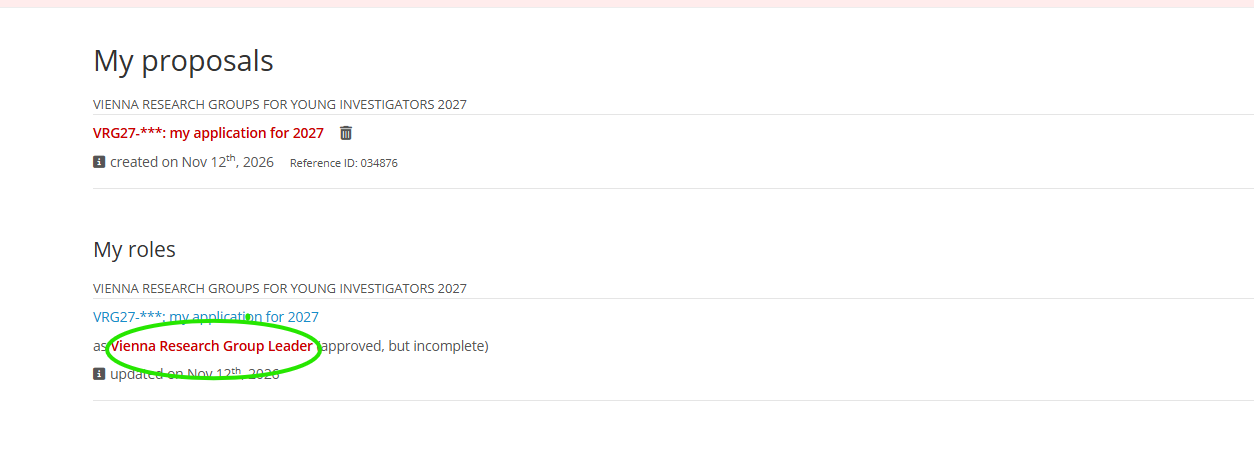
If you want to change your CV in the course of the submission process, you have to click "refresh from profile" in the section "my role". Otherwise, an old version of the CV will be portrayed in the final proposal.
Step 4: Fill out the missing information in the proposal tab "VRG Leader & Proponent".
VRG27 / Overview of chapters
Go to “My proposals and roles” in the top menu and click on the incomplete proposal. The proposal is organized in seven chapters (as tabs):
- Basic Information
- VRG Leader & Proponent
- Host and Partner Institution(s)
- Work Programme
- Integration of the Proposed Group Leader
- Budget
- Uploads
VRG27 / Details of chapters
Go to “My proposals and roles” in the top menu and click on the incomplete proposal. The proposal is organized in seven chapters (as tabs).
Basic Information
To be filled out by the VRG candidate.
Enter basic information as indicated.
Scientific Disciplines
When entering the scientific disciplines, fields will be suggested as you type. Please use the ÖFOS categories as issued by Statistik Austria.
Application Track
Select the application track you are applying in. Please note that as a VRG candidate you can only submit one proposal to the call.
Reviewer Suggestions
You have to suggest five reviewers and can optionally exclude up to three reviewers (certain persons, not entire institutions / departments).
For the reviewer suggestions, please take care of the following parameters:
- Please do not suggest reviewers who have a known conflict of interest with the VRG candidate and/or the proponent.
- Please do not include persons at Austrian institutions, as the proposals will be strictly reviewed internationally only.
The information provided is only visible to WWTF office.
Excluded Reviewers
You can exclude and suggest certain persons, not entire institutions or departments. The information provided is only visible to WWTF office.
VRG Leader & Proponent
To be filled out by the VRG candidate.
This chapter contains the data of the main applicants of the proposal (i.e. VRG candidate and proponent). The VRG candidate and the proponent can input and edit information. Ideally, information about VRG candidate and proponent have already been entered.
The VRG candidate needs to add the following information on career steps so far and highlights of recent work.
Career steps to date
Provide information on the groups in which the VRG candidate has worked up until now.
Highlights of recent work
Add highlights here. Include non-scientific career milestones, as WWTF considers unconventional research careers.
Description of (scientific) leadership potential
Including relevant experience inside and outside the academic context and a vision for leading and managing the prospective group in Vienna.
Applicants motivation
Provide the candidate’s motivation for applying to this position.
Confirmation of eligibility
Confirm that you have worked at a research institution outside of Austria at least two years within the last three years. Confirm that you are not currently employed in Austria at the time of submission of the proposal.
Information on the proponent
Check if the proponent has already filled out their profile and completed the section "my role".
Host and Partner Institution(s)
To be filled out by the future Viennese host institution and the VRG candidate.
Description of host institution (specific department/institute)
The future host institution (specific department/group) should be outlined. It should be more than a general description, specifically tailored at the host environment of the VRG candidate.
Motivation of host institution/proponent to bring the VRG candidate to Vienna
The motivation of the host institution to bring the VRG candidate to Vienna must be clearly established. Why is the VRG candidate the right fit for your institution? Amongst others, describe (complementary) competencies and research interests the VRG candidate will bring to the institution. Also describe, why the proponent chose to apply together with this candidate.
Further partner institutions (optional)
You can add further partner institutions.The criteria for "partner institutions" are the following:
- Partner institutions are different from those of proponent's host institution
- Partner institutions are a substantial part of the project, which means they either receive or give (monetary) contributions.
- By adding a partner institutions, you can allocate budget to this institution in the "budget" chapter, which is particularly relevant in case of a cooperation with a researcher at this institution.
Wider research network
Insert information about the wider research network and describe additional institutions and research groups with which the VRG candidate intends to collaborate in Vienna.
Work Programme
To be filled out by the VRG candidate
Scientific abstract
Please provide a concise scientific abstract. This will be used in approaching reviewers.
Work programme
- The work programme must be uploaded as a single PDF file with a maximum of eight pages (including references). Use the template provided from the funding portal, and make sure to stick to the formatting guideline!
-
- It includes the state of the art in the proposed field and scientific challenges in the next years and the research plan
- Give a concise review of the subject of research, of the state of the art in the proposed scientific field and the scientific challenges the VRG candidate wants to address with their future research group.
- Formulate the concrete research question(s) you would like to address and specify the objectives to be achieved and the theoretical and methodological approaches.
- Try to outline your work programme as concretely as possible and give the jury a clear picture that you know which work packages to start with.
- A clear vision and outline of future research are expected. The file may include figures, charts, etc. Please use the template provided. Make clear how your research fits the call topic.
-
- Please also upload a GANTT chart outlining your project (1 page).
Please note that the references in the work programme refer to the references used when writing the work programme (the bibliography). The "relevant references" section further below should highlight key publications in your respective research area.
Ethical considerations
Please state why / why not your proposed project contains potential ethical aspects. Please follow the research ethics guidelines of your host institution. If the planned project requires ethical approval, it is the obligation of the VRG candidate to acquire it as soon as it is needed. Please describe in the online submission shortly the necessity of an ethical approval, the process of acquiring it and possible challenges.
Open science statement
Please explain your intentions about providing access to publications and to shareable research data (e.g. sharing, accessibility, metadata, sustainability, ownership). For more information refer to the Open Science Policy.
Use of generative AI
Please describe if and how genAI has been used in your proposal. For more information refer to this page.
Gender considerations
Please indicate, where in the proposal you have considered gender relevant aspects. For more information on what gender relevant aspects need to be considere, go to this page. As page numbers are only available in the proposal PDF, you can work around and use the section title of the funding portal tabs or the sub-headings of your work programme where the information can be found. This information should allow the reviewers and jury to evaluate, whether and how gender aspects have been considered in the proposal process.
Disclosure of other applications for funding
Applicants agree to provide full information in all related matters. The project cannot be subject to double funding. If you mark the check box “yes”, please also insert more information in the textbox. WWTF reserve its rights to check for double funding with other funding organizations.
Relevant references
List the key publications representing the state of the art in the respective research area. Please be aware of the maximum of 20 references. Mark the 10 most relevant references by clicking on the check box “Most relevant”. Please note that this is not your personal publication list (your personal publication list should be included in the CV)!
-
- The system can import publication data from external databases, e.g., by DOIs. For PubMed: use the number of pubmed.gov. For arXiv, use only the numbers without “arXiv:”
- Use a uniform reference style. If you import references through the database lookup, please use the style of the imported reference for the references entered manually.
Integration of the Proposed Group Leader
To be filled out mainly by the future Viennese host institution
Selection process
Please describe the selection process for the VRG candidate (search process, principles of selection and criteria applied). If there was a search committee, briefly describe its role, the persons involved, and the search criteria applied. Please include gender mainstreaming measures / affirmative actions here. Female scientists in Austria are clearly underrepresented in leading positions which is, among other reasons, due to gender biases in selection procedures. It is a goal of WWTF and of the Austrian scientific community to overcome these biases. What measures were applied to attract women as VRG candidates? Please describe your institution’s policy to avoid gender biases.
Active recruitment procedures
As stated in the Call Specifications, active recruitment procedures with the aim of finding VRG candidates of the Viennese university/research institution are mandatory. Please indicate via the check box if this has been done. Please indicate in what journal(s) the ad has been published, and which further channels have been used. Upload one job announcement (as PDF) as an example. The uploaded file is for WWTF office only.
Career advancement of VRG candidate
Describe the contractual relationship with the VRG candidates and her/ his status within the host institution during the whole funding period, as well as the concrete steps leading to a tenured position.
Describe the contractual relationship with the VRG candidate and their status within the host institution throughout the whole funding period. The provision of a clear-cut career plan is mandatory. Explain in detail the steps leading to a tenured position (for example the process of receiving a “Qualifizierungsvereinbarung” including time frames). The details provided here will be the foundation for contractual negotiations in the case of funding. Refer to the Call Specifications for further details.
Interim evaluation
Carrying out an interim evaluation of the VRG Leader is obligatory. The host institution is obligated to conduct an interim evaluation of the VRG leader. This evaluation should take place in the middle of the Vienna Research Group funding period, but not later than at the beginning of the fifth year. An international element in the evaluation is necessary (e.g., the involvement of a reviewer from abroad). The publication record and the research profile of the VRG leader must be subject of the interim evaluation. Further aspects might be included by the host institution. Please describe here the concrete schedule and the planned evaluation process. Please note that the interim evaluation should be organized together with WWTF. Different scenarios for the interim evaluation are specified in the Call Specifications.
Long-term career perspective after the end of the WWTF grant
WWTF is convinced that long-term perspectives for researchers are a prerequisite to hire excellent researchers. What is the long-term career perspective of the VRG candidate (e.g., path to full professor) after the funding period? Please describe the host institution’s structures and policies for achieving this. What is the host institution’s strategy for a long-term perspective/tenure track? What is the prospective development of the group after the funding period?
Integration of the group leader at the future host institution
What measures are taken for the integration of the VRG candidate into the institute/department of the host institution and between other partners like universities/facilities/departments/institutes? What support will the VRG candidate receive upon arrival (administration, housing, onboarding, …)? How will the access to administrative resources be organized?
Budget
To be filled out mainly by the VRG candidate.
For details about eligible costs, indirect costs and in-kind contributions, please refer to the Call Specifications.
- All institutions added in the chapter “VRG Leader & Proponent” as well as partner institutions added in the chapter "host and partner institutions" will be listed automatically in the budget table.
- All figures are in € and in full numbers!
- At least 80% of the requested funding must be allocated to the region “Vienna”. Up to 20% may be allocated to other partner(s).
- Non-personnel costs should not exceed 30% of the overall budget. If non-personnel costs exceed 30% of the total budget, a justification must be included in the budget.
Planning of personnel costs
- The VRG candidate will be inserted automatically (after confirmation of "my role").
- Before you can start the calculations about personnel, you must add a row for every person by clicking “Additional persons”.
- Please click the funding source (WWTF, in-kind, WWTF & in-kind) and then add the average yearly time commitment for each project year. The column with the years (“Y1, Y2, …”) will be automatically updated as soon as you have entered the project duration in “Basic Information”. Finally, for those persons where WWTF funding is requested, fill in the salary corresponding to a 100% employment in the first project year. This is the “Brutto-brutto-Jahresgehalt”, i.e., gross yearly salary including all expenses for the host institution as well. Please be aware of the Austrian labour cost system.
- The total funding applied for each person will then automatically be calculated including a 3,5% annual salary increase (accounting for inflation/..). At the bottom right you will see the total personnel costs applied for from WWTF.
- If you want to include a pay raise of the VRG candidate, you have to add another row to depict the pay raise.
For the VRG candidate: please ask your future host institution what your actual salary will be beforehand!
Note: Please be aware that the wage for “Studentische Mitarbeiter*in” (i.e. Diploma student etc.) is calculated by FWF with 20 hours and a “Doktorand*in” (i.e. PhD student) with 30 hours per week.
Planning of non-personnel costs
Please provide a concise description of costs per cost category/institution as well as the funding applied for. Click “add another row” to include another cost factor. Please be as specific as possible (e.g., list devices etc.)! You can use the same categories multiple times. The sums will be automatically calculated and provided in the table “Cost overview” and “Budget per region”.
Furthermore, please fill in the text boxes:
- Please shortly describe the envisioned group: How will the group be set up? Which positions/qualifications are needed and when, to conduct the research?
- Briefly describe the equipment and consumables needed to successfully perform the group’s research. Describe the availability and accessibility of the infrastructure and equipment. What will be funded by WWTF, what will be provided by the host institution?
- Please indicate by clicking the check box that you are aware of the host institution’s overhead policy (max. 20%).
- Please describe the monetary and in-kind contributions in detail. Please be aware that the monetary and in-kind contributions are the contributions from the host institution only and must exceed the minimum requirements stated in the Call Specifications.
Uploads
Affirmations
The VRG candidate and proponent confirm their participation in the project via the "affirmation" tick-box in the section "my role". The confirmation date will be displayed in this section.
Authorization/Signatures
Submission of the proposal requires the signatures of the authorized person(s) at the future host institution of the VRG candidate (“Authorization”). Please consult your institutional research services regarding the person mandated to sign the proposals and allow sufficient time to obtain their signature. The Funding Portal automatically suggests a name, you can change and edit this name in the online form. This information will be included in the PDF to be signed.
- Download the PDF using the link “You can generate the signature sheet here”.
- Signatures may be provided in various formats: Add a scanned or physical signature, and upload the form; or
Insert an electronic signature (e.g., A-Trust, Handysignatur) and upload the form. Please note that electronically signed PDFs cannot be merged into a single document.
Doctoral Degree confirmation
Upload the VRG candidates doctoral degree certificate. This should include information on the date you obtained your doctoral degree on.
Reference letter (optional)
- Optional: reference letter(s) for the VRG candidate.
- You can invite up to three experts to upload a Letter of Reference for your VRG proposal.
- Max. 2 pages per LoR, no experts from the future host institution.
- The letter will not be accessible to the VRG candidate, they will only get a notification in case a letter has been submitted.
- If relevant, you may upload further information (e.g., patents, Letters of Intent, ..) as PDFs. Please note that a maximum of 5 documents are permitted, with a maximum of 3 pages per document.
The reference letters have to be submitted together with the proposal on the application deadline date. Reference letters can not be considered otherwise.
VRG27 / Proposal submission
Once all symbols are green, the proposal can be submitted. The submit button is in the last chapter at the bottom.
- Please check your proposal again for accuracy of the information provided before submitting it. You can download the proposal PDF anytime.
- After the indicated deadline, submission is not possible anymore. Hence, unsubmitted proposals will be excluded from the following evaluation process. Further documents, such as reference letters, cannot be handed in after the submission date.
- You can access your submitted proposal on the page “My Proposals and Roles”.
Please note that only the VRG candidate can submit the proposal.
No changes are possible after the project has been submitted.
VRG27 / Contact
Petra Steinkogler | +43 1 402 31 43 14 | petra.steinkogler@wwtf.at
Grace Liu | +43 1 402 31 43 12 | grace.liu@wwtf.at