Please write the full proposal in a way that allows assessment by both expert reviewers and a broad high-level jury panel.
##### Overview of the full proposal phase - Deadline for submission of full proposals: July 30, 2026, 2pm CET - The reviewing by external experts commences in August - Meeting of jury panel to select projects for funding: Late November 2026 - Funding decision of WWTF's Board of Directors: December 2026 - Announcement of Results: December 18, 2026.Please note that only the coordinating PI (PI&C) can **submit** the proposal.
#### **Accessing your proposal** 1. Go to [https://fundingportal.wwtf.at/](https://fundingportal.wwtf.at/) 2. Login with your credentials 3. You will see an overview of your proposal(s) and role(s) under the menu “My Proposals & Roles" [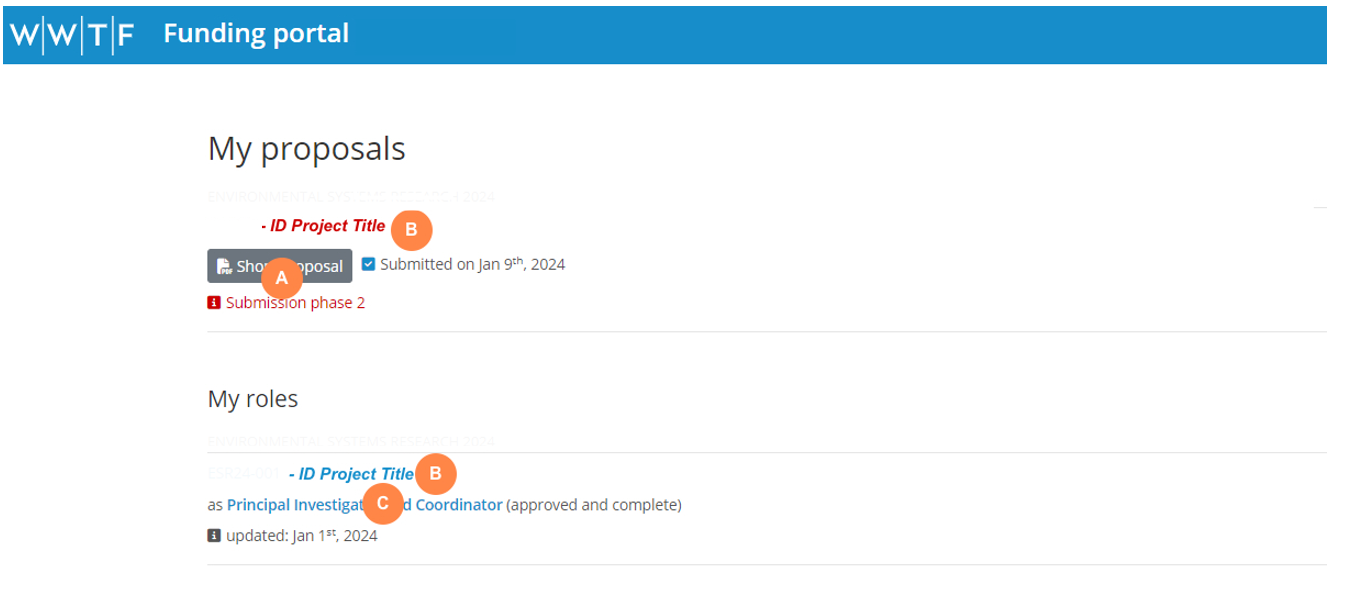](https://wiki.wwtf.at/uploads/images/gallery/2025-03/nWDDNxOkZZEGybZW-image.png) - **A **Click on “Short Proposal” to download a PDF of your submitted short proposal - **B **Click on the project title to edit the full proposal - **C** Click on your role to edit your specific role in this proposal #### **Update information about PIs**Contact details, CV, and information about your role in the project have been automatically transferred from the short proposal to the full proposal. Please ensure the information in the tab "My Profile" and "My Roles" is up-to-date. Only update information if required.
##### Step 1: Update your profile information if required Upon login, go to “My Profile” in the top menu to update your profile. To update your CV, delete the previous document and upload a new CV as PDF. The requirements regarding the CV in the full proposal are the same as those in the short proposal . Please review these requirements [here](https://wiki.wwtf.at/books/user-guide-funding-portal-rl4/page/cvs). ##### Step 2: Update information about your specific role in the proposal if relevant Go to “My Proposal & Roles” in the top menu. Under “My Roles”, click on your role below the title of the proposal. - - You can update the personal information by clicking on “Refresh from profile”. The system will check if there is new information in “My Profile” and update this section accordingly. Should you have uploaded a new CV in "My Profile", it will now be transferred to the full proposal. - The requirements regarding the description of your specific role in the full proposal are the same as those in the short proposal. Please review these requirements [here](https://wiki.wwtf.at/link/839#bkmrk-step-3%3A-complete-you). *Please note that the information entered here should be specific to the project. If you are participating in multiple proposals that require different subsets of your expertise, please tailor the information according to the project. Click [here](https://wiki.wwtf.at/books/user-guide-funding-portal-rl4/page/cvs) for further information on how to update your CV when participating in more than one project.* ### **II. Proposal Chapters** #### **General Information** The full proposal is comprised of six chapters, each under a separate tab: - Basic Information - Personnel and Institutions - Project - Budget - Signatures A chapter with a **red alert** symbol indicates that it is incomplete. Within the marked chapter, click on the red symbol(s) beside individual sections to highlight the fields requiring attention. A **green checkmark** indicates that the information in the chapter is complete.Please note that the symbols might not refresh immediately even if the information in the chapter is complete. Changing to another chapter and going back to the other will refresh the symbol.
#### **Chapter Basic Information**The name, acronym, nominated scientific disciplines, project duration and type of project (regular WWTF Project or Joint Project) can **no longer** be changed.
- **Keywords**: These will help the WWTF identify appropriate reviewers for your proposal. Keywords may still be edited or added. - **Suggested peer reviewers**: Applicants must suggest **five** international peers whom they deem qualified to review the proposal. To enable the selection of a balanced set of reviewers, please provide keywords or phrases to describe the reviewers’ fields of expertise. Suggested reviewers must be based - **outside of Austria** and - have **no conflict of interests** with project applicants (complete team and collaborators). Persons with whom the project applicants have worked together (joint publications, research cooperations, etc.) in the last five years will not be considered. - Please note that the WWTF will decide if suggested peers will be contacted for reviewing, and WWTF may take different reviewers to those you suggested. As a rule, WWTF will include a maximum of two reviewers suggested by the applicants. The other reviewers are suggested by the jury and/or WWTF office to avoid bias. - **Excluded peer reviewers**: Applicants may, without stating any reasons, exclude up to three individuals from reviewing their proposal. The names of the peer reviewers suggested and excluded by the applicants will be shared with the jury panel but not disclosed to potential reviewers themselves. Each proposal is reviewed by no less than three reviewers. #### **Chapter Personnel and Institutions**The addition, removal, or substitution of core team members (PI&C, co-PIs) are **not** permitted at this stage. WWTF may make exceptions in well-argued circumstances (e.g., a co-PI moving to an institution abroad or leaving the academic field).
Should well-justified changes in the core team be necessary, please contact WWTF. WWTF reserves the right to exclude projects from further evaluation in cases in which PIs can no longer be part of the project team. **Further partner institutions**: Collaborating institutions beyond those of the core team members can be added in this stage. Please note that every person involved in the project must be linked to an institution in order to allow indication of time commitment and salary in the “Budget” section. A **signature** will be required from the authorizing persons at the core team members’ institutions and at all further partner institutions. A maximum of **five different institutions** (including those of the core team members) is permitted. Should a project be funded, the addition of further collaborations will be possible. #### **Chapter Project** This is the main section of the proposal that requires elaboration of the project’s scientific content.Please note that the character limit includes spaces.
##### **Lay summary** (*max. 1,200 characters*) Please provide a description of your proposed research in German that is suitable for the general public. This will primarily be used by WWTF for communicating your work to non-experts for fundraising and public relations purposes. ##### **Scientific abstract** (*max. 2,000 characters*) Please provide a concise scientific abstract of the project. This will be used in approaching reviewers. The abstract has been taken automatically from the short proposal, but may be edited for the full proposal. ##### **Work program** (*max. 14 pages*)Please use the template provided for download in the WWTF Funding Portal. **Instructions on how to use the template are in a box directly in the template document.** References are included in the 14 pages.
##### **Ethical considerations** (*max. 1,000 characters*) If available, the ethical approval (final or preliminary) or confirmation of submission of an ethical approval should be submitted. If an ethical approval for the proposed work has yet not been granted, applicants must provide a timeline and an explanation of the feasibility of obtaining the necessary ethical approvals. In the latter case, applicants commit themselves to obtaining the required permits to commence the project in a timely manner, should it be selected for funding.Upon selection for funding, submission of the final ethical approvals to WWTF is a prerequisite for the funding contract. As projects must start no later than 6 months after funding approval, grantees must ensure that ethical approvals are submitted to WWTF in time for the funding contract to be concluded.
##### **Data management** (*max. 500 characters*) Please explain how you deal with the data in your project (sharing, accessibility, metadata, sustainability, ownership). ##### **Use of generative AI **(max. *500 characters*) Please describe if and how GenAI has been used in developing your research proposal. WWTF recognizes that the use of genAI tools is pervasive and can facilitate proposal writing, for example in relation to improving written language. However, substantial use of genAI must be declared as such for the sake of transparency.“Substantial use” is defined in line with the European Commission’s definition: “\[…\] using generative AI as a basic author support tool is not a substantial use. However, interpreting data analysis, carrying out a literature review, identifying research gaps, formulating research aims, developing hypotheses, etc. could have a substantial impact.” (EC 2024: Living Guidelines on the responsible use of generative AI in research.)
This mainly concerns critical parts of scientific relevance, such as hypothesis formulation and the scientific project plan. Applicants will be required to provide statements on the use of generative AIs at both the short and full proposal stages. WWTF emphasizes the importance of human responsibility for the content submitted at all stages of the application process.WWTF does not allow the use of genAI in the evaluation process.
Please note that ****potential sex/gender aspects of the research topic** **and** **gender balance in the research team** **should be considered throughout the application (see [here](https://wiki.wwtf.at/books/gender-equality-plan)). These should be briefly described where appropriate in the relevant sections.
#### **Budget** Please note the following guidelines for the budget: - Maximum 15% difference between the budgets of the short and full proposals is permitted. - Non-personnel costs should not exceed 30% of the total requested budget.The budget table requires assigning a person to an institution in order to calculate the budget per institution. Therefore, please first add the institutions under “Personnel and Institutions.”
##### **Personnel costs** - Core team members of the short proposal are automatically listed in the respective table. - Click “Additional person” to individually add all persons who will work on the project. Please provide their name or select “is N.N.” if the role is to be filled (e.g., PhD candidate, Post Doc). Indicate the affiliation and staff category of each person using the dropdown menu. If an affiliation is not listed, return to the section “Personnel and Institutions” and add the respective institution. Each person must be assigned to an institution. - Specify if the person will be financed by WWTF or contribute on an in-kind basis, and indicate their yearly time commitment to the project for each year (full time equivalents). A mixture of WWTF and in-kind financing is permitted. - For persons financed by WWTF, enter the annual salary that corresponds to 100% annual gross costs in the first year of the project (employer and employee costs = gross costs / “Brutto-Brutto-Jahresgehalt”). Please note that PhD positions are often calcuated on a 75% employment basis. The total funding requested for each person will be automatically calculated. - For personnel costs, an annual 3.5% p.a. increase in salary over the lifetime of the project has been pre-programmed. This is intended to assist with planning only, and actual salaries should be paid according to institutional or collective agreements. Please use baseline salaries according to the date you expect to start the project, that is 2027. Please contact your institutional research support services in this matter. ##### **Non-personnel costs** - Add rows to provide a concise overview of all non-personnel costs directly related to the project. Please select the institution and cost category from the dropdown menus. If an affiliation is not listed, return to the section “Personnel and Institutions” and add the respective institution. - Costs for basic infrastructure (rent, telephone) are not permitted. Costs for larger equipment essential for the project may only be requested on a pro rata basis that also takes into consideration the proportion of time that the equipment will be used for this project. - WWTF strongly encourages open access publications. Costs for Article Processing Charges (APCs) may be requested. - Costs for data management purposes (e.g., curation, storage) are eligible. ##### **Budget per region** - The share of the budget allocated to the regions “Vienna” and “Other” will automatically be shown for WWTF projects, and to the regions “Vienna”, “Lower Austria” and “Other” for Joint Projects. - For regular WWTF projects, at least 80% of the requested funding must be allocated to the region “Vienna”. Up to 20% may be allocated to other partner(s), including partners in Lower Austria. - For Joint Projects, the budget allocated to the region “Vienna” must be at least 51%. The share of the budget allocated to the region “Lower Austria” may range from 21% to 49%. Up to 20% may be allocated to any further partner(s) located in other regions (“Other”). ##### **Cost overview** - Enter the overhead rate for each institution. WWTF permits a maximum of 20% overheads costs. Please consult each institutions’ research services to ensure compliance with all institutions’ internal regulations. ##### **Explanation of Cost Planning** (*max. 2,500 characters*) - Please provide an explanation of cost planning principles, also indicating access to resources that are already available. ##### **Disclosure of other applications for funding** (*max. 750 characters*) - If you have applied for funding for this project (or parts thereof) at other organisations, please indicate this here. This will not impact the evaluation of this proposal. - Double submissions will be reviewed by the FWF. This means that the FWF will receive the list of projects and check whether a similar project has already been submitted to the FWF. - WWTF does not allow double funding. If your proposal is selected for funding by both WWTF and another funding organisation, we will ask you to decide which funding you will accept. #### **Chapter Signatures**Submission of the proposal requires the signatures of the authorized person(s) at the host institutions of each of the PI&C and co-PIs (“Authorization”). For the full proposal, also signatures of further institutions added are required.
- Please consult your **institutional research services** regarding the person mandated to sign the proposals and plan sufficient time to obtain their signatures. - Enter the name of each authorized person in the online form. This information will be included in the PDF to be signed. In case that the institution has applied before, the system suggests already a signing person. Please check if this is still the person authorized to sign. **You can overwrite the suggested entry manually.** - Download the PDF using the link “You can generate the signature sheet here”. - Signatures may be provided in various formats - Add a scanned or physical signature, and upload the form; or - Insert an electronic signature (e.g., A-Trust, Handysignatur) and upload the form. Please note that electronically signed PDFs cannot be merged into a single document.Please note that signatures do not have to be on the same sheet. The upload of multiple signature files is possible.
Please ensure signatures are dated. Undated signatures will not be accepted.
# ICT26 Digital Humanism / Details of Chapters (Short Proposal)**Please go to the [User Guide Funding Portal](https://wiki.wwtf.at/books/user-guide-funding-portal-rl4) for all general matters, e.g. regarding creating your profile, roles, CVs, etc. **
Please note that the inclusion of figures and tables is not possible in the short proposal. These elements can be included in the full proposal.
##### **Chapter "Basic Information"** This chapter contains basic information about the proposal, including title, scientific disciplines involved, keywords, duration, and type of project (i.e., regular WWTF Project or Joint Project). Fill out fields as required. Please note: - **Scientific Disciplines:** Fields will be suggested as you type. WWTF uses the [ÖFOS classification system of Statistik Austria.](https://wiki.wwtf.at/books/osterreichische-systematik-der-wissenschaftszweige-ofos) Please find the best match possible. Please note that WWTF uses these categories for statistical purposes only. It is not used for the assessment of individual projects. A maximum of 4 different scientific disciplines is possible. - **Keywords:** These will help us to ensure appropriate reviewers for your proposal. - **Joint Project:** Please indicate if this proposal is a Joint Project, i.e. includes partners from Lower Austria with a higher share possible from the overall project budget. For details regarding team composition and budget distribution, please see [here](https://wiki.wwtf.at/books/ict26-digital-humanism/page/ict26-digital-humanism-project-partners-outside-of-vienna-joint-projects-with-partners-in-lower-austria). ##### **Chapter "Personnel and Institutions"** This chapter contains information about the main parties in the project. Please see [here](https://wiki.wwtf.at/books/user-guide-funding-portal-rl4/page/create-roles-pi-co-pis-for-a-proposal) how to invite PIs to the project. - **Co-PIs** can be added to the project. Please note the maximum of three PIs in the core team. - **Additional partner institutions** beyond those of the core team members can be added under “Further Partner Institutions”. (The institutions of the PI&C and co-PIs are automatically added by the system.) Entering an additional institution provides the option of allocating budget to this institution in the “Budget” chapter. This may be important in case of collaboration with researchers at institutes other than those of the core team members. - A maximum of **five different institutions** may be involved in the proposal. This includes the institutions of the PI&C and co-PI(s).Before proceeding to the Chapter "Budget", please make sure that all PIs and CoPIs have been invited (and that they filled our the Profile and Role) and that all additional partner institutions are added. The Budget tool of the online form needs this information to allocate the cost lines to institutions. If this step has not been completed, the system might miscalculate the budget.
##### **Chapter "Project"** This chapter contains the main part of the scientific information regarding the project. - **Abstract:** The abstract may not exceed 2,000 characters. It may include the following aspects: (i) wider research context & theoretical framework; (ii) hypotheses, research questions & objectives ; (iii) methodological approaches; (iv) innovative aspects; (v) relevance and potential impact. The abstract should be written (1) for the jury composed both of SSH and ICT scholars and experts, (2) for potential reviewers. Potential reviewers are approached with the abstract to see if the reviewer is able to assess the proposal. - **Proposal (Scientific Work Programme):** This part is the main scientific content of the proposal. ist must no exceed 17,500 characters (incl. spaces). It shall cover the following aspects: (1) Introduction and background (2) State-of-the-art including theoretical considerations (3) Research questions, hypotheses, objectives (4) Methodological approaches (novelty, feasibility) (5) Relevancy and innovativeness of the proposed project (6) Expected scientific and societal impact There are no specifications regarding the number of characters for the subsections of this part. The length of the subsections can be adjusted to the needs of the planned work. - **Relevancy to Digital Humanism:** Please describe concisely how your planned work aligns with the idea of Digital Humanism and how your work aims to further it. - **Interdisciplinary collaboration and promotion of younger researchers:** Please describe here how you aim to organize the interdisciplinary collaboration in your team between SSH and ICT and how you promote the education and career of the younger researchers in your team, in particular against the background of the challenges of interdisciplinary collaboration. - **Ethical considerations*** (max. 1,000 characters): *Indicate if there is an ethical approval necessary as a formal requirement to conduct of your research project. Outline the potential ethical aspects of your proposed project. These may include, but are not restricted to human participants, the use personal data, but also the use of artificial intelligence. If no ethical aspects are identified, please also provide an explanation. Note that only providing a cursory statement (e.g., "no ethical aspects") will not be regarded as sufficient consideration of ethical aspects by the applicants. For more details, see [here](https://wiki.wwtf.at/books/ict26-digital-humanism/page/ict26-digital-humanism-guidelines-for-good-scientific-practice-and-ethics-incl-ai-use-in-proposal-writing). - **Use of generative AI ***(max. 800 characters): *Please describe if and how GenAI has been used in developing your research proposal. Please find further details [here](https://wiki.wwtf.at/books/ict26-digital-humanism/page/ict26-digital-humanism-guidelines-for-good-scientific-practice-and-ethics-incl-ai-use-in-proposal-writing). ##### **Chapter "References"** In this chapter, up to 18 key references relevant for the project can be added. Please use a continuous reference style.Please note that these references should focus on the content of the proposal and is not your personal publication list. The latter should be included in the CVs of the core team members.
You may use lookup tool provided by the system by entering the DOI of the publication . However, it may not find the correct full reference in all cases. Type in manually instead. ##### **Chapter "Budget"** The short proposal requires only an overview budget for each participating institution. All institutions added in the chapter “Personnel and Institutions” will be automatically listed in the budget table.Make sure that all institutions are added before in the "Personnel and Institutions" chapter.
1. Enter the sum for personnel costs at each institution. Please consider that, in the full proposal, you will be required to enter the annual gross costs (employer and employee costs = gross costs / “Brutto-Brutto-Jahresgehalt”) of all individual researchers. If you are unsure about the annual gross costs, please consult your institutional research service. Due to projected inflation rates, the full proposal system will automatically calculate a 3.5% p.a. increase in salaries over the lifetime of the project. 2. Enter the total non-personnel costs for each institution. For details about eligible costs, please see [here](https://wiki.wwtf.at/books/ict26-digital-humanism/page/ict26-digital-humanism-eligible-costs). 3. Enter the overhead costs for each institution. Note that up to 20% overhead costs may be claimed. Please consult your institutional research service also in this regard.The system will automatically calculate sums and ratios of the budget.
- Based on the information provided, the share of the budget allocated to the regions “Vienna” and “Other” will be shown for WWTF projects and to the regions “Vienna”, “Lower Austria” and “Other” for Joint Projects. - For “regular” WWTF projects, at least 80% (i.e., ≥80%) of the requested funding must be allocated to the region “Vienna”. Up to 20% may be allocated to other partner(s) (including partners in Lower Austria). - For Joint Projects, the budget allocated to the region “Vienna” must be ≥50%. The share of the budget allocated to the region “Lower Austria” must be between 20–49%. Maximum 20% may be allocated to further partner(s) located in other regions (“Other”). - The proportions of the budget allocated to personnel and non-personnel costs are also shown. Please note that, in this call, non-personnel costs should not exceed 30% of the total budget. - The system will display an alert if the inserted amounts exceed the permitted funding distribution across regions or cost types. - Please note that changing the proposal between “WWTF Project” and “Joint Project” types will reset the budget table due to differing budget distribution requirements. **Explanation of Cost Planning** *(max. 750 characters)* Outline details about the planned allocation of resource allocation as requested in the budget.In the case of an invitation to submit a full proposal, there should not be significant changes in the requested budget compared to the short proposal. Exceptions are permitted but require justification.
##### **Chapter "Signatures"** Please see [general user guidelines](https://wiki.wwtf.at/books/user-guide-funding-portal-rl4/page/authorizing-signatures-FXx).